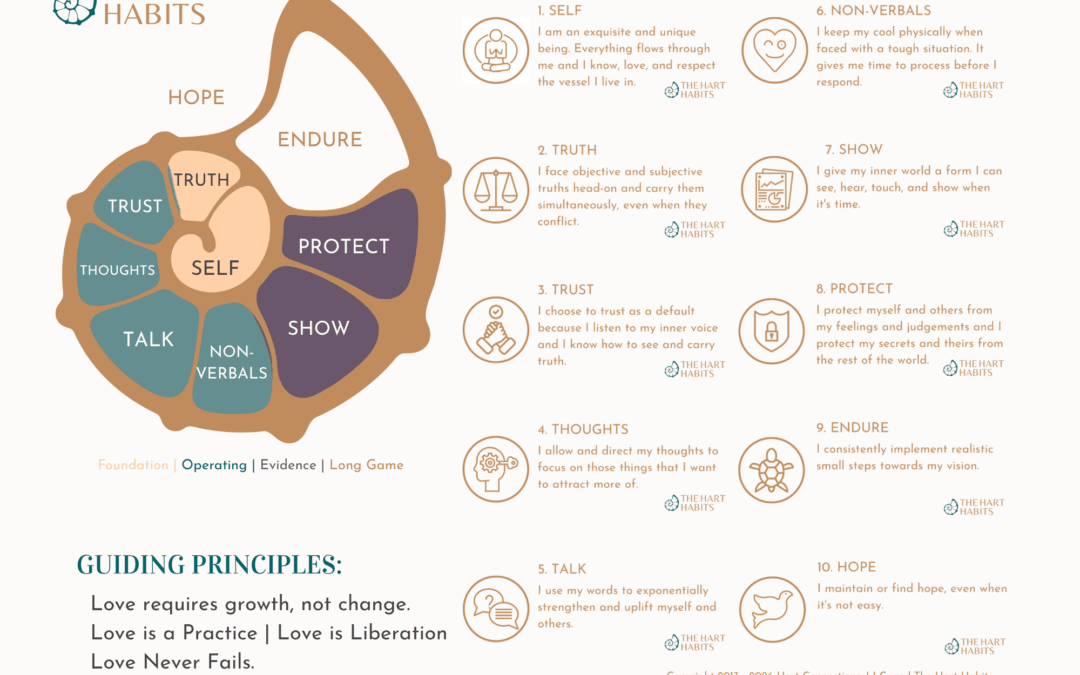
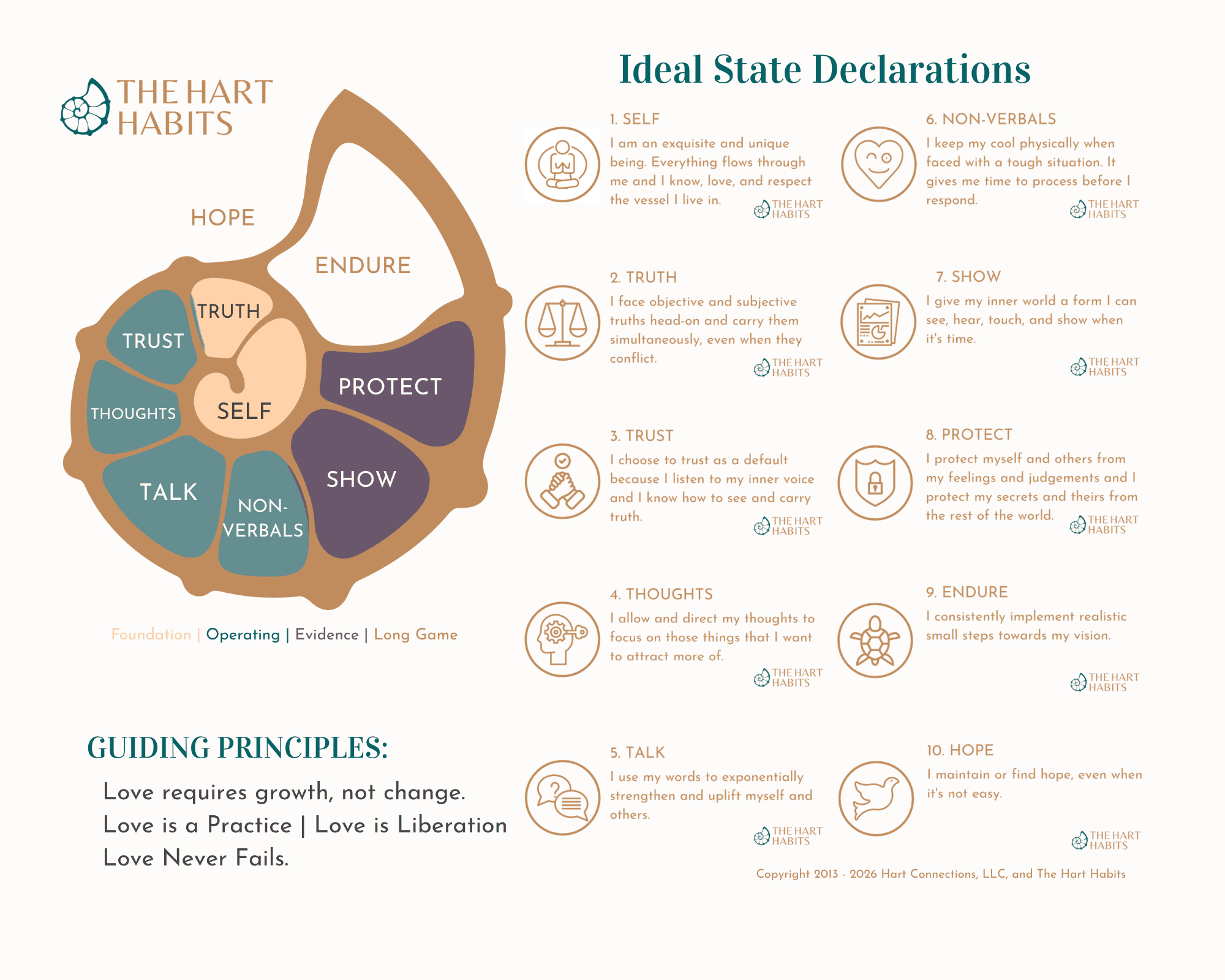
Here is The Hart Habits framework I built and have used to help hundreds of people navigate their relationships, both personal and professional.
Since you've made it this far, it's time for you to see the easy framework I built to help you apply these principles every day, any time, with a moment's thought.
I've been developing this framework for the last 15 years. You'll notice a few things about it.
There is a nautilus shell. This is a sea animal, and there's real significance to its shape and to how it's used in this design. You'll also see 10 Habits listed out, each with a mantra of one or two sentences at most. And underneath the shell, you'll find the guiding principles, which explain what the shape means and how the whole thing fits together.
Guiding Principle #1 — Love Requires Growth, Not Change
This refers to the nautilus shell itself, and the animal that grows in this particular shape.
If you've studied trigonometry, geometry, or any of the maths, you know about the Fibonacci spiral. The nautilus shell displays that in a beautiful way. You see this spiral shape throughout nature, a kind of perfect math.
The interesting thing about the nautilus is that as it grows, it doesn't change its shape. It simply gets bigger. That's the same as love.
In our society, we've misinterpreted love, and I was guilty of trying to be someone that another person would want. Unfortunately, that someone kept changing depending on who the other person was, because I was trying to be who they wanted. That meant I wasn't actually myself for any of them. I was lying to all of them, and I was lying to myself.
So the first guiding principle of the Hart Habits, and of love as I've defined it through this framework, is that it requires growth, not change. Love doesn't need you to be anything different than you are. You are perfect exactly as you are right now. Everything about you is perfect right now.
Will you grow over time? Yes. Will you change over time? Probably. But love doesn't require you to change. Love loves you just like you are, in any given moment.
Guiding Principle #2 — Love Is a Practice
These 10 Hart Habits need to be practiced consistently over time. Practiced that way, they become easier and easier to implement, and they all work together to strengthen and reinforce one another. You can't just take the framework one day and, boom, life is a success the next. I've been working on it for 15 years. Hopefully it only takes you a year or two of intentional practice to see some massive changes in your life. But that depends on how intentionally you put them into practice.
Guiding Principles #3 and #4 — Love Is Liberation, Love Never Fails
I started this work because of the saying that love never fails, but it had failed me a lot. I built The Hart Habits on a model of love I understood, but it grew into the one I'm sharing with you today, because my wish, at the very beginning, was to understand this concept of love from a practical standpoint. I wanted to understand how to do it. How do I live love? How do I implement it? Because I had been doing what I thought it was, and I was hopeless and in terrible shape, and I didn't understand why.
That's why love was the foundation of what I've built. I believe love is liberation, and that as we apply these principles to our own lives, our relationships, our decisions, and our families, we can bring liberation for all of us. Thinking and acting this way causes us to do things, in our spheres of influence, that provide liberation, justice, and space for everybody to exist exactly as they are. That's a big dream. But who would I be, doing this work, if I didn't have a big dream?
The Four Layers
The 10 Habits aren't just a list, they're built in four layers, and each one does something different.
Foundation comes first: Self and Truth. Both are work you do with no one else in the room. Self is knowing and respecting your own vessel. Truth is your capacity to hold objective and subjective reality at once. Neither one requires another person to exist or be practiced. They're what you bring to a relationship before there's a relationship to bring anything to.
Operating is next: Trust, Thoughts, Talk, and Non-Verbals. These are the four running in real time, while you're actually with someone. Trust is the stance you bring to them. Thoughts is what's happening internally while you're together. Talk and Non-Verbals are the two channels you're communicating through, word and body. This is the moving machinery of a relationship in motion.
Evidence comes after that: Show and Protect. This is the layer where things become visible and provable. Show is literally about giving your inner world a form others can see, hear, and touch. Protect is the flip side: what you choose to guard, and how you hold what someone else has shown you. Together, these are where trust gets built through consistent, visible follow-through, or breaks because the evidence doesn't match the words.
Long Game comes last: Endure and Hope. These two are different from the other eight in two ways. First, they're not only Habits you practice, they're also what you receive as evidence that the other eight are working. Second, only one of them stays entirely personal. Endure is the discipline of consistent small steps, sustained by you, over time. Hope does that too, but it doesn't stop at the individual. Hope reaches outward, into your relationships, your network, your community, and draws on them as part of how it's built and renewed. That's why Hope sits last: it's both the outcome of everything before it holding together, and the point where the whole practice stops being just about you and starts being about everyone you're in relationship with.
The Ten Hart Habits
I'll walk through the placement of each Habit here, without diving too deeply into any one of them. Each has its own dedicated page where you can go deeper.
The first part to focus on is the model itself, the nautilus shape. You'll notice the very first, central word is Self. Because if you don't know, love, and respect the vessel you walk in, you cannot bring your full potential to anything else in this world. No relationship, no job, no parenting role, nothing. You can't bring your full self if you don't know who your full self is.
Foundation
Habit 1 — Self
I am an exquisite and unique being. Everything flows through me, and I know, love, and respect the vessel I live in.
This is key: everything flows through you. When I talk about truth, I talk about the difference between objective and subjective truth. When we really think about it, almost everything we believe to be true is subjective. It has to come through our brain, our body, and our filter for us to receive it. Understanding and appreciating that is the key to seeing things as objectively as possible. I break Self down into four areas: Strengths, Shadow, Spirit, and Boundaries.
I face objective and subjective truths head on and carry them simultaneously, even when they conflict.
Truth is number two for a reason. Everything else has to be based on understanding how to come back to what is true, both objectively and subjectively. Learning to appreciate, celebrate, and take those things into account as you make other decisions in your life makes a world of difference.
I allow and direct my thoughts to focus on those things that I want to attract more of.
Notice both words: allow and direct. On one hand, thoughts happen in your brain, and we can't be conscious of all of them. On the other, we can be conscious of a lot of them, and we can allow them to come and go, appreciate them, see what they tell us, and let them float away. We can also consciously direct our thoughts toward the things we want to attract more of.
I use my words to exponentially strengthen and uplift myself and others.
Once we understand how to evaluate our thoughts, we can use our words to invoke movement in the energy around us. I've talked before about how talk can put things to death, like getting our secrets out in a safe place and putting to death the shame we've been living with. We can also use talk to strengthen and uplift ourselves and others. Our words carry real power, and it's worth knowing how to use them well.
I keep my cool physically when faced with a tough situation. It gives me time to process before I respond.
When we're conscious of our thoughts, intentional with our talk, and aware of what our non-verbals communicate, we can curate a beautiful life. Giving ourselves a moment before responding is where we find our growth, as Viktor Frankl would say.
I give my inner world a form I can see, hear, touch, and show when it's time.
This is a very practical Habit, and it refers to the process of taking things out of our brain and putting them into a form we can see. I talk about using paint, sculpture, writing, a journal, an exercise log, a calendar, or any number of other mediums. The point is to get things out of our body and into a tangible form, so we can create our vision, track our progress, and see and celebrate our success.
I protect myself and others from my feelings and judgments, and I protect my secrets and theirs from the rest of the world.
I will never be flippant about how hard this Habit can be to implement. I highly recommend therapy if this is one you struggle with, because you need to get things out, but in a safe environment. I've experienced how hard it can be to get mental health coverage in our system. Don't give up. You're worth getting the help you need, and there are resources available. Look into online programs like betterhelp.com or talkspace.com, or check your local university for learner-staffed therapy programs that sometimes work on a sliding fee scale.
Sometimes it really isn't easy. But when you're practicing the other Hart Habits, it gets a little easier, and you know how to tap into your network, your connections, and your community, to find hope for yourself and for the people around you.
If you've made it this far, through all 14 parts of this series, thank you. That's not a small thing. Anxiety and negative thoughts don't get quieter because you read one post. They get quieter because you keep showing up, one Habit at a time, the way you just did.
What We Covered
Over these 14 posts, we walked through talking about trauma, training your brain, boundaries, strengths, shadow work, Spirit, truth, trust, non-verbals, protecting your secrets, endurance, and hope. That's most of the Hart Habits, each one a different angle on the same underlying question: how do you stop letting anxiety and negative thoughts run the show?
There's no single fix in any one of these posts. That was never the point. The point was giving you real tools, one at a time, so you'd have a whole toolbox by the end instead of one thing that might not fit your specific moment.
Four Things Worth Remembering
A few principles ran underneath all of it, worth repeating here as you head into wherever you go next.
Love requires growth, not change. You don't have to become someone else to be worthy of love, or hope, or peace. You're allowed to grow without being asked to become unrecognizable to yourself.
Love is a practice. Every Habit in this series works the same way: better with repetition, not with one perfect attempt. I've been practicing these for fifteen years. Give yourself real time, not a weekend.
Love is liberation. When you actually practice these Habits, in your relationships, your work, your own head, it doesn't just change you. It changes what you're able to offer the people around you too.
Love never fails. Even when it feels like it has, even when people have failed you using love as their excuse, the practice itself still holds. That's different from any one person getting it right.
Where to Go From Here
Everything in this series is one piece of a larger system. If you want to see how all 10 Hart Habits fit together, in one place, the Hart Habits Framework page lays out the whole thing: the nautilus shape, the guiding principles, and how each Habit builds on the one before it.
You don't have to master all of it today. You just have to keep going.
Question of the day: Which of these 14 posts hit you the hardest, and why?
Trigger Warning: mention of rape, abuse, drug use, suicidal thoughts, and toxic whiteness.
It's uncomfortable and scary to get vulnerable, but freedom is on the other side.
I took a year to step back and re-evaluate everything I'd been building. It was a brutally painful process, peeling back things I'd spent thousands of hours building and promoting. I had to admit that not everything that glitters is gold. Some of it was fool's gold, or a mirage. Some of it was just garbage I'd assigned value to. I had to weigh my innermost thoughts against the principles of freedom and justice for all.
Before I go further, gratitude first: I live a privileged life that gave me the space to go through a process like this at all. This society isn't built to give most people the tools or room to actually connect with themselves. My husband is an actual saint, and I'm grateful to be on this road with him.
I also want to be honest about how hard this was. It's difficult to teach an old dog new tricks, and it's hard to feel like I'm starting over, again. But I learned something vital in the process: the cycle of creation, destruction, and re-creation isn't bad. It's magical. The pain becomes the beauty of the journey.
Where This Series Comes From
Part of my creative process over the past several months has been the videos and posts I've shared, on relieving anxiety, on aligned entrepreneurship. Now I'm digging into my third favorite topic: spirituality, and our connection to "God" and each other. I put God in quotes because my understanding of that word has shifted a lot from the Big Guy Up There I used to picture.
There's a thread running through everything I've shared so far, and it's time to name it: relationships. Everything I've learned points to the same thing, that healthy relationships, with ourselves, with the people and nature we share this world with, and with Spirit, God, the Universe, whatever you call it, are what actually create freedom and justice for everyone.
Love is the answer. But as a society, we don't really know what love is, because we've spent over 400 years suppressing real love in favor of global wealth hoarding and "religious freedom." The love of money is the root of a lot of evil, and this country is a pretty clear demonstration of what that looks like after four centuries of chasing it at any cost.
Where I Started
I grew up in a very conservative, very white town in rural North Idaho. I attended a private Christian school at my church, preschool through graduation, out on a prairie in the middle of nowhere. The whole school had about 50 kids in it. I graduated in a class of one.
I was an overachiever and a perfectionist, so I graduated two years early and started community college at 16. But first, I spent six months in Mexico on a "mission" trip. The pinnacle of being a good Christian white kid was going on a mission trip, even a short one. I did a full six months, alone, so you can see the overachiever streak started early. It was fun, a real adventure, though I'm not sure I accomplished any actual mission. Mexico was sufficiently "poor," so it counted, and I was on my way to inevitable success. As a bonus, I came home feeling very "woke," because I'd spent months with Mexican families and been a minority in a brown world.
I was a very good Christian girl. Until I wasn't.
What Happened the Summer Before My Senior Year
Fast forward a couple years, to the summer before senior year of college. I was still a "good" girl, technically, though I'd had some fun, tried some things, lost my virginity, and genuinely believed I needed to straighten up if I ever wanted to get married, which was the ultimate goal back then.
In my search for love, without understanding the wounds I already carried, I was exactly the kind of prey a serial rapist looks for, and one had just re-entered society in my parents' hometown. He befriended me. He came to church with me. He came to my family's home. He took me to his family's house. After a few weeks of carefully building trust, he got me alone and raped me.
I didn't even know to call it rape at the time. I believed it was my fault. I told myself I deserved it, because I wasn't a virgin anymore, or because I'd gone somewhere with him, so he must have assumed I wanted it. I knew for certain I'd said no, that I'd pleaded with him to stop, more than once. I blamed myself anyway for putting myself in that position.
That night, he drove me home in his two-seater Mazda, an hour from my parents' house. We didn't have cell phones then. It was a long, quiet ride.
Three days later, I got a diagnosis: herpes, and twelve other STDs. I sat in the doctor's office and cried while she told me I wouldn't be able to give birth naturally because of what had happened to me. I called him, told him what he'd given me, told him I forgave him, and told him we couldn't see each other anymore. Then I left to be the youth pastor on a weekend trip to a Christian music festival.
My first morning back, his mugshot was in the local paper. He'd led police on a chase through town after breaking into a woman's home, raping her at knifepoint, and stealing her wallet. As the story unfolded and he went to prison, I learned his charges included serial child rape, that he'd assaulted several girls my age and younger, and that when I met him that summer, he'd only just been released from prison for a previous rape conviction.
Seven Years of Silence
I was in a daze trying to grapple with all of it. My life spiraled downward for seven years before I told anyone besides my younger sister what had actually happened, or admitted, even to myself, that it was rape.
Every single day of those seven years, I thought about how I'd explain to my mother why I couldn't give birth naturally. I thought about how to tell anyone I dated about the herpes, whether or not I told them the story behind it. The stigma followed every part of my life, heavy with shame.
Back at school for my last year of college, I turned to cannabis to cope. I know now that therapy would have been a far better choice, but at the time, therapy and antidepressants carried just as much shame as premarital sex or cannabis did in the world I lived in. I picked the sin that felt best in the moment, and quietly resigned myself to being a bad person underneath it all. I was never fully committed to that story, though, because I still genuinely loved being kind and doing good in my community. I even chose social services over corporate work after graduating, instead of using my business degree to climb a ladder. I wanted a life I loved, even though I believed the tradeoff was staying poor forever. I was willing to accept that as my punishment for not being perfect.
It's chilling to look back now and see how openly shame hid inside my choices and my beliefs about myself. It took years to recognize that I was always working to be worthy of love, because underneath it, I didn't believe I already was.
The Breaking Point
Eventually the shame and the disconnection from my own spirit wore me down completely, and after escaping a five-year abusive relationship, I knew something had to change.
So I decided to quit cannabis, go back to church, and get my life "right." I started therapy. I finally told my parents about the rape. I thought that would be the last piece that got me back on track.
Since I was already starting over, I moved across the country to join the family business, thinking it would be a couple of years while I finished my Master's in Family Life Education. I wanted to eventually help people build better family relationships, somehow. I hadn't fully figured out how yet, and a comfortable family-business paycheck seemed like a fine way to finish my studies in the meantime.
I got distracted from my coursework almost immediately, the way shame-based decision-making tends to work, and quit my master's program with just months left, to go rescue the family business instead. Notice the pattern of trying to be the one who saves everything? That thread runs through this whole story.
A couple years after that, my mental health was genuinely wrecked.
The Moment at My Desk
One day, sitting at my desk, overwhelmed by responsibility and completely unsupported, I had a moment of total clarity where I suddenly understood why people take their own lives. Ending mine seemed, for a moment, like the most plausible solution to everything I was carrying.
If you're experiencing suicidal thoughts right now, please reach out to the 988 Suicide & Crisis Lifeline. You can call or text 988, anytime. You are not alone in this, and you deserve support.
I told myself it wasn't okay to think that way, and walked down the hall to tell a friend I'd hired that I'd just had that thought. At the time, I'd been back in church, cannabis-free and celibate, for almost four years. I couldn't understand why I felt this way when I was doing everything I believed made a person good, everything that was supposed to earn a good life.
I sang in the choir. I led the youth group. I went to every service. I served as an armor bearer for the pastor's wife. I ran the business, hired a lot of people, bought a house, let other single women live with me rent-free, and even managed to pull the business through hard times successfully.
But I knew I wasn't okay. So I finally let go.
I let go of working with my family. I let go of church. I let go of trying to be chaste and sober. I let go of every expectation I had about what came next, or who I was supposed to be.
I didn't know, letting go of all of it, whether I'd ever be caught. I knew the version of love I'd learned didn't feel good, and didn't make sense. I didn't know if I'd learned it wrong, been taught it wrong, or if it had been a lie from the start.
So, like any good overachiever, I decided to tear apart everything I'd learned about love and rebuild it, living unapologetically as myself, sins and all. I did go into hiding to do it, but inside that hiding place, I finally did what I wanted.
Only a couple of months later, I met my now-husband. He gave me a safe place to actually exist as myself while I dug into what love really was, and how to live it.
That process took almost fifteen years to become what's now The Hart Habits. It took a long time to emerge, but every part of the path mattered in getting me here. There were no mistakes along the way. It was heartache, disappointment, joy, fun, reflection, white privilege, uncomfortable truth, and endless questions, and I'm beyond grateful it led me here.
Who I Am Now
Now I can hold all of my identities at once, and I see the vastness of "God" more clearly than I ever have. That skill lets me see other people through the same lens of radical love and celebration. When I say I love you, I mean it from the depth of my soul. I say it almost every day, to almost everyone I talk to.
I'm still a work in progress. But the more connected I get to Source, the more aligned with my own energetic purpose, the more the universe's mysteries reveal themselves in ways too phenomenal not to share.
As an Aries sun with a Gemini moon, a Libra ascendant, and a chart full of fire signs, I'm not an easy pill to swallow for a lot of people. Think of me as a big ball of fire. Excellent for some things. Difficult in plenty of others. That's why this one's called An Aries Guide to Woo-Woo.
I'll say things that piss some people off. I don't mind that. I'll simplify complicated, nuanced topics enough that you know your first real step. That's the thing I'm actually good at. I'll push you to learn, test, try, fail, and try again, through every excuse you've got, because I've used them all myself. I will tell you I love you, every time, and I will mean it, every time.
The mission is simple: help myself, and anyone who wants to come along, learn how to care for and love ourselves, each other, our earth, and our resources, the way God loves us, so we can survive what's coming and build something beautiful together.
Let the circus begin.
Recommended resources: Conversations with God by Neale Donald Walsch Calm
Question of the day: How do you connect to your inner spirit? Has that changed over time, or stayed the same?
Manage Consent
To provide the best experiences, we use technologies like cookies to store and/or access device information. Consenting to these technologies will allow us to process data such as browsing behavior or unique IDs on this site. Not consenting or withdrawing consent, may adversely affect certain features and functions.
Functional
Always active
The technical storage or access is strictly necessary for the legitimate purpose of enabling the use of a specific service explicitly requested by the subscriber or user, or for the sole purpose of carrying out the transmission of a communication over an electronic communications network.
Preferences
The technical storage or access is necessary for the legitimate purpose of storing preferences that are not requested by the subscriber or user.
Statistics
The technical storage or access that is used exclusively for statistical purposes.The technical storage or access that is used exclusively for anonymous statistical purposes. Without a subpoena, voluntary compliance on the part of your Internet Service Provider, or additional records from a third party, information stored or retrieved for this purpose alone cannot usually be used to identify you.
Marketing
The technical storage or access is required to create user profiles to send advertising, or to track the user on a website or across several websites for similar marketing purposes.