[What a few weeks we've had here in the United States.
For some, it's been a time of lifetime dreams coming true. For others, it's a blatant display of disregard for the life they've been fighting to extend for generations and generations.
Throw a birthday in the mix and it's the perfect recipe for drunken fireworks accidents and mass shootings by white terrorists at the city parade.
All of it encouraged me to share some thoughts and strategies I've developed over the years that have resulted in me feeling like I still have hope, even in these tumultuous times.
I share this because I love you, and I want all of us to make it through this healthy, happy, and with equity in our system. I can't do much about your happiness, but I can share what undergirds mine, and maybe you'll find some tools you can use too.
Is It Real to Say "I Have Hope"?
So is it authentic, or ostentatious, for me to say "I have hope" when the whole world appears to be going to hell in a handbasket?
Only you can decide what's true for you. But I will say I loved Susan Cain's book, Bittersweet, because it helped me understand why I can exist so easily at the intersection of grief and hope. As an Amazon Associate, I earn from qualifying purchases.
I've done it for a long time, so I promise it wasn't easy or an overnight process. You may or may not be like me in that way, but I promise, even if you aren't, you can find hope even in desperate times. I say this with so much confidence because of who I've chosen to learn from over the past 8 years or so.
Where the Hope Series Starts: Looking in the Mirror
To keep this simple, I broke my thoughts down into a series called How to Have Hope in Desperate Times. Right now, there are 7 bite-sized videos that represent months of work. I'll spread them out here on the blog, with context and resources for each one.
Before we dive in, here's your warning: the next four posts are about looking in the mirror.
That's how important our own self is in the recipe of how to have hope. We have to dig in deep to the who, what, how, why, and when of our individual existence on this planet. I'll take you through that thoroughly over the next four posts.
But right now, go look in a mirror and tell yourself: "Wow. You are awesome. A miracle. A real gift to the world."
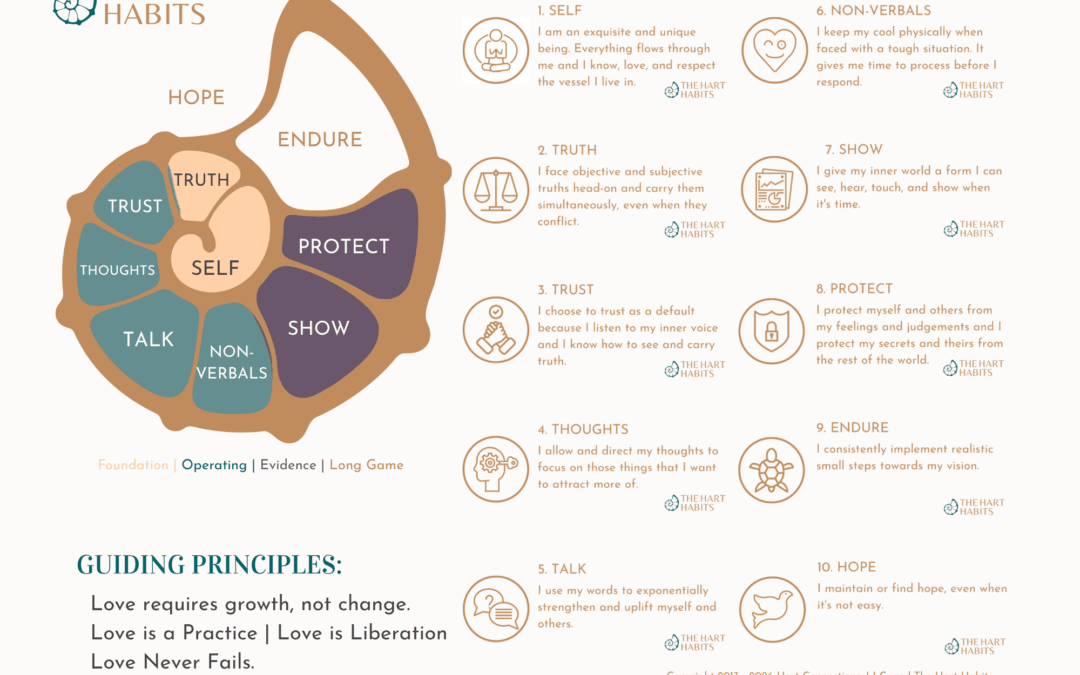
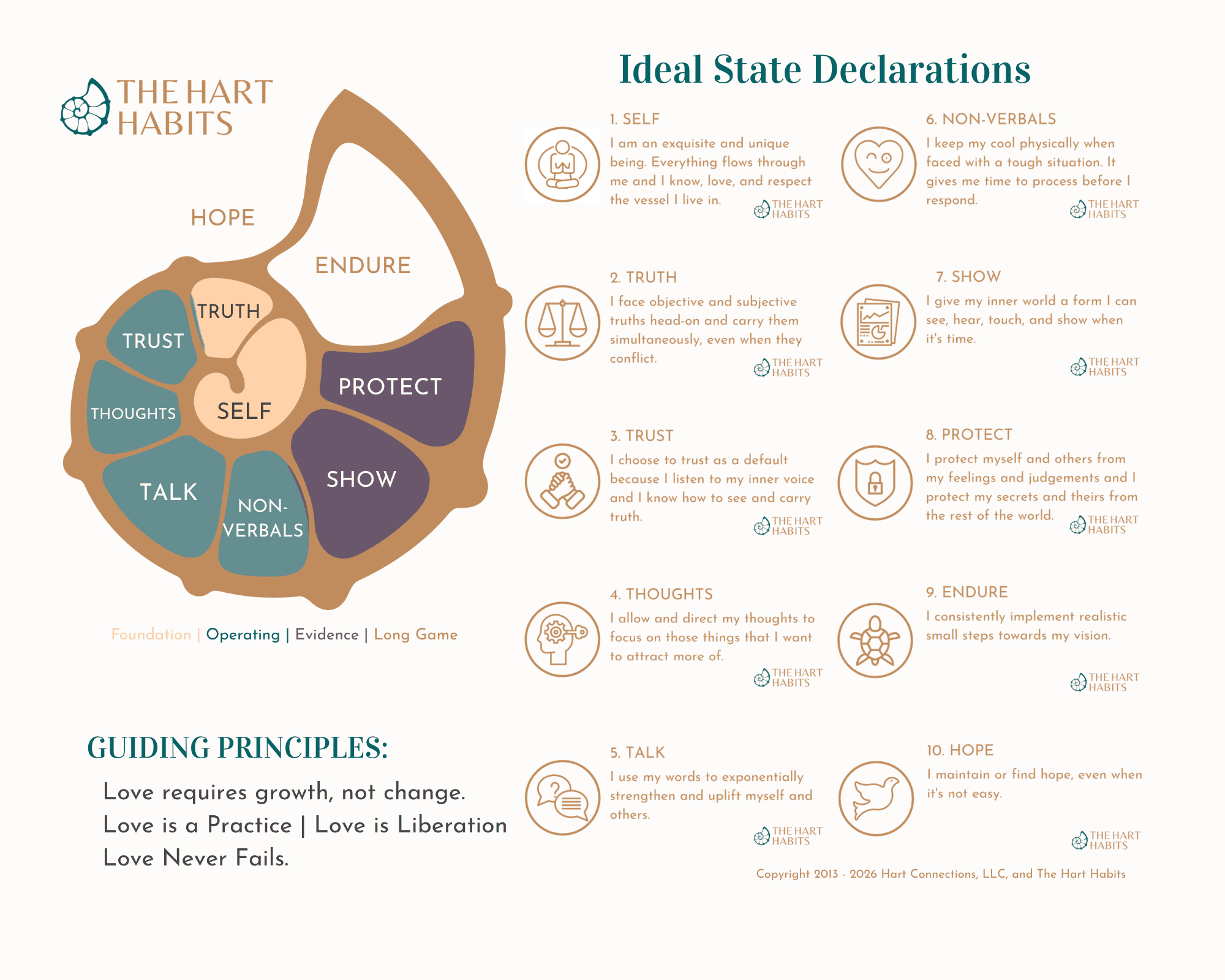
Here is The Hart Habits framework I built and have used to help hundreds of people navigate their relationships, both personal and professional.
Since you've made it this far, it's time for you to see the easy framework I built to help you apply these principles every day, any time, with a moment's thought.
I've been developing this framework for the last 15 years. You'll notice a few things about it.
There is a nautilus shell. This is a sea animal, and there's real significance to its shape and to how it's used in this design. You'll also see 10 Habits listed out, each with a mantra of one or two sentences at most. And underneath the shell, you'll find the guiding principles, which explain what the shape means and how the whole thing fits together.
Guiding Principle #1 — Love Requires Growth, Not Change
This refers to the nautilus shell itself, and the animal that grows in this particular shape.
If you've studied trigonometry, geometry, or any of the maths, you know about the Fibonacci spiral. The nautilus shell displays that in a beautiful way. You see this spiral shape throughout nature, a kind of perfect math.
The interesting thing about the nautilus is that as it grows, it doesn't change its shape. It simply gets bigger. That's the same as love.
In our society, we've misinterpreted love, and I was guilty of trying to be someone that another person would want. Unfortunately, that someone kept changing depending on who the other person was, because I was trying to be who they wanted. That meant I wasn't actually myself for any of them. I was lying to all of them, and I was lying to myself.
So the first guiding principle of the Hart Habits, and of love as I've defined it through this framework, is that it requires growth, not change. Love doesn't need you to be anything different than you are. You are perfect exactly as you are right now. Everything about you is perfect right now.
Will you grow over time? Yes. Will you change over time? Probably. But love doesn't require you to change. Love loves you just like you are, in any given moment.
Guiding Principle #2 — Love Is a Practice
These 10 Hart Habits need to be practiced consistently over time. Practiced that way, they become easier and easier to implement, and they all work together to strengthen and reinforce one another. You can't just take the framework one day and, boom, life is a success the next. I've been working on it for 15 years. Hopefully it only takes you a year or two of intentional practice to see some massive changes in your life. But that depends on how intentionally you put them into practice.
Guiding Principles #3 and #4 — Love Is Liberation, Love Never Fails
I started this work because of the saying that love never fails, but it had failed me a lot. I built The Hart Habits on a model of love I understood, but it grew into the one I'm sharing with you today, because my wish, at the very beginning, was to understand this concept of love from a practical standpoint. I wanted to understand how to do it. How do I live love? How do I implement it? Because I had been doing what I thought it was, and I was hopeless and in terrible shape, and I didn't understand why.
That's why love was the foundation of what I've built. I believe love is liberation, and that as we apply these principles to our own lives, our relationships, our decisions, and our families, we can bring liberation for all of us. Thinking and acting this way causes us to do things, in our spheres of influence, that provide liberation, justice, and space for everybody to exist exactly as they are. That's a big dream. But who would I be, doing this work, if I didn't have a big dream?
The Four Layers
The 10 Habits aren't just a list, they're built in four layers, and each one does something different.
Foundation comes first: Self and Truth. Both are work you do with no one else in the room. Self is knowing and respecting your own vessel. Truth is your capacity to hold objective and subjective reality at once. Neither one requires another person to exist or be practiced. They're what you bring to a relationship before there's a relationship to bring anything to.
Operating is next: Trust, Thoughts, Talk, and Non-Verbals. These are the four running in real time, while you're actually with someone. Trust is the stance you bring to them. Thoughts is what's happening internally while you're together. Talk and Non-Verbals are the two channels you're communicating through, word and body. This is the moving machinery of a relationship in motion.
Evidence comes after that: Show and Protect. This is the layer where things become visible and provable. Show is literally about giving your inner world a form others can see, hear, and touch. Protect is the flip side: what you choose to guard, and how you hold what someone else has shown you. Together, these are where trust gets built through consistent, visible follow-through, or breaks because the evidence doesn't match the words.
Long Game comes last: Endure and Hope. These two are different from the other eight in two ways. First, they're not only Habits you practice, they're also what you receive as evidence that the other eight are working. Second, only one of them stays entirely personal. Endure is the discipline of consistent small steps, sustained by you, over time. Hope does that too, but it doesn't stop at the individual. Hope reaches outward, into your relationships, your network, your community, and draws on them as part of how it's built and renewed. That's why Hope sits last: it's both the outcome of everything before it holding together, and the point where the whole practice stops being just about you and starts being about everyone you're in relationship with.
The Ten Hart Habits
I'll walk through the placement of each Habit here, without diving too deeply into any one of them. Each has its own dedicated page where you can go deeper.
The first part to focus on is the model itself, the nautilus shape. You'll notice the very first, central word is Self. Because if you don't know, love, and respect the vessel you walk in, you cannot bring your full potential to anything else in this world. No relationship, no job, no parenting role, nothing. You can't bring your full self if you don't know who your full self is.
Foundation
Habit 1 — Self
I am an exquisite and unique being. Everything flows through me, and I know, love, and respect the vessel I live in.
This is key: everything flows through you. When I talk about truth, I talk about the difference between objective and subjective truth. When we really think about it, almost everything we believe to be true is subjective. It has to come through our brain, our body, and our filter for us to receive it. Understanding and appreciating that is the key to seeing things as objectively as possible. I break Self down into four areas: Strengths, Shadow, Spirit, and Boundaries.
I face objective and subjective truths head on and carry them simultaneously, even when they conflict.
Truth is number two for a reason. Everything else has to be based on understanding how to come back to what is true, both objectively and subjectively. Learning to appreciate, celebrate, and take those things into account as you make other decisions in your life makes a world of difference.
I allow and direct my thoughts to focus on those things that I want to attract more of.
Notice both words: allow and direct. On one hand, thoughts happen in your brain, and we can't be conscious of all of them. On the other, we can be conscious of a lot of them, and we can allow them to come and go, appreciate them, see what they tell us, and let them float away. We can also consciously direct our thoughts toward the things we want to attract more of.
I use my words to exponentially strengthen and uplift myself and others.
Once we understand how to evaluate our thoughts, we can use our words to invoke movement in the energy around us. I've talked before about how talk can put things to death, like getting our secrets out in a safe place and putting to death the shame we've been living with. We can also use talk to strengthen and uplift ourselves and others. Our words carry real power, and it's worth knowing how to use them well.
I keep my cool physically when faced with a tough situation. It gives me time to process before I respond.
When we're conscious of our thoughts, intentional with our talk, and aware of what our non-verbals communicate, we can curate a beautiful life. Giving ourselves a moment before responding is where we find our growth, as Viktor Frankl would say.
I give my inner world a form I can see, hear, touch, and show when it's time.
This is a very practical Habit, and it refers to the process of taking things out of our brain and putting them into a form we can see. I talk about using paint, sculpture, writing, a journal, an exercise log, a calendar, or any number of other mediums. The point is to get things out of our body and into a tangible form, so we can create our vision, track our progress, and see and celebrate our success.
I protect myself and others from my feelings and judgments, and I protect my secrets and theirs from the rest of the world.
I will never be flippant about how hard this Habit can be to implement. I highly recommend therapy if this is one you struggle with, because you need to get things out, but in a safe environment. I've experienced how hard it can be to get mental health coverage in our system. Don't give up. You're worth getting the help you need, and there are resources available. Look into online programs like betterhelp.com or talkspace.com, or check your local university for learner-staffed therapy programs that sometimes work on a sliding fee scale.
Sometimes it really isn't easy. But when you're practicing the other Hart Habits, it gets a little easier, and you know how to tap into your network, your connections, and your community, to find hope for yourself and for the people around you.
If you've made it this far, through all 14 parts of this series, thank you. That's not a small thing. Anxiety and negative thoughts don't get quieter because you read one post. They get quieter because you keep showing up, one Habit at a time, the way you just did.
What We Covered
Over these 14 posts, we walked through talking about trauma, training your brain, boundaries, strengths, shadow work, Spirit, truth, trust, non-verbals, protecting your secrets, endurance, and hope. That's most of the Hart Habits, each one a different angle on the same underlying question: how do you stop letting anxiety and negative thoughts run the show?
There's no single fix in any one of these posts. That was never the point. The point was giving you real tools, one at a time, so you'd have a whole toolbox by the end instead of one thing that might not fit your specific moment.
Four Things Worth Remembering
A few principles ran underneath all of it, worth repeating here as you head into wherever you go next.
Love requires growth, not change. You don't have to become someone else to be worthy of love, or hope, or peace. You're allowed to grow without being asked to become unrecognizable to yourself.
Love is a practice. Every Habit in this series works the same way: better with repetition, not with one perfect attempt. I've been practicing these for fifteen years. Give yourself real time, not a weekend.
Love is liberation. When you actually practice these Habits, in your relationships, your work, your own head, it doesn't just change you. It changes what you're able to offer the people around you too.
Love never fails. Even when it feels like it has, even when people have failed you using love as their excuse, the practice itself still holds. That's different from any one person getting it right.
Where to Go From Here
Everything in this series is one piece of a larger system. If you want to see how all 10 Hart Habits fit together, in one place, the Hart Habits Framework page lays out the whole thing: the nautilus shape, the guiding principles, and how each Habit builds on the one before it.
You don't have to master all of it today. You just have to keep going.
Question of the day: Which of these 14 posts hit you the hardest, and why?
If anxiety and negative thinking have left you feeling hopeless, you are here on purpose, and I have a message especially for you.
I Called Bullshit
As I was developing The Hart Habits, I came across a verse that said "love always hopes." I'd personally been in plenty of places where love, specifically, had left me feeling especially hopeless.
Before anything else: if you're feeling hopeless right now, I understand. I've been there. And you matter, that's why I'm here, writing this. If you need support right now, the 988 Suicide & Crisis Lifeline is available anytime, call or text 988. We want you here. I want you here.
Hope is a skill you can actually learn, practice, and get better at. But it turns out hope is also, scientifically, an outcome of practicing the other nine Hart Habits. I didn't know that when I started this process. It just turned out to be true.
Hart Habit Ten: Hope
The tenth and final Hart Habit is Hope. The declaration: I maintain or find hope, even when it's not easy.
It's easy to say "just find hope, just hold onto it," as if that's all there is to it. I've personally been in places where I couldn't have found hope if I wanted to. I did want to, and I couldn't find it anywhere. I had to reach for practical tools that felt safe, the same system I'm sharing with you now. They worked. They got me through those hopeless stretches. That doesn't mean I never go through hopelessness or anxiety anymore. It means I now have tools to get through it, and to actively build more hope in my life overall.
Hope Is a Thinking Process
Hope has been studied by scientists, what it is, how it works, what it actually does for people. The clearest framework for this comes from psychologist C.R. Snyder's Hope Theory, first published in 1991 and later expanded in his book The Psychology of Hope: You Can Get There From Here. What Snyder found is that hope is a thinking process made up of three parts: goals, pathways, and agency.
If it's a thinking process, that means it's something we can apply for ourselves. If we can become conscious of our thoughts, we can apply this process to them.
Goals
The first element is goals. This loops back to Hart Habit one, Self, knowing and understanding who you are, what matters to you, your boundaries, your visions. It also pulls in a bit of Habit seven, Show, putting your visions into written, audible, artistic, or any other tangible format.
The first part of hope is having goals of your own, taking the time to actually know yourself and what you want. If you're feeling hopeless, start there: what do you want? What are your goals?
Pathways
The second element is pathways, how you can actually reach those goals. What's distinct about this part of the research is that it isn't pie-in-the-sky fantasy thinking. It's about realistic pathways, the routes that genuinely exist for you to get there. Scientifically, this is about facing the truth, Hart Habit two, head-on, not blind positive thinking.
Agency
The third part is agency, your actual ability to travel those pathways and reach those goals. I break this into two pieces.
Internal agency is about your thoughts. Yes, physical agency matters too, and it varies a lot for each of us, but what doesn't vary much is our ability to access our conscious thoughts, Hart Habit four. We often blame our capacity to hope, or not, on outside circumstances. But science shows hope has more to do with how we align our thoughts toward our goals, and endure the difficulties that inevitably come up, which is Endure, Hart Habit nine. By practicing the Hart Habits consistently, you build the capacity to access hope, because you've built the tools to tap into your own manifesting agency. You can ask and answer: what's the goal? What's the realistic path? What resources are around me? How can I move toward that goal, even a little?
External agency is the final, most crucial piece, and the one that ties hope to the people around you in a way none of the other nine Habits quite do. Everything up to this point has been internal work. Hope is the Habit that reaches outward.
Hope Requires Community
Connecting to community is how we find the pathways we can't generate alone. We don't have every pathway inside ourselves. We need people, support, and resources around us to help us find and actually use them. As we understand what those pathways look like, we understand our own agency better too, because now we know what our team looks like.
I love Pamela Slim's book The Widest Net, because a wide enough net catches plenty for all of us. We each have a real net of people in our lives, and as we strengthen our connections to each other, hope rises, and it gets easier for all of us, because we can lean on each other when we need to.
All the other Hart Habits feed into this. When you practice them regularly, you build relationships with room for people to be themselves, room for you to be yourself, trusting and edifying relationships you build together, not alone.
Wrap Up
If you're struggling with Hope specifically, you'll likely feel resigned to your circumstances, pessimistic, expecting the worst. If that's where you are, there's help. See above.
If you're not quite there, and just want to build this Habit intentionally, these steps will help, and so will practicing the whole framework together.
There's one more piece: an overview of how the whole Hart Habits framework fits together, which you can find on the Hart Habits Framework page.
When you practice Hope consistently, you'll start to feel optimistically expectant, regardless of circumstances. You'll be able to hold the full truth and weight of what we're dealing with, and still know that better things are coming, and that we'll work toward that better good together.
Recommended resources: The Widest Net by Pamela Slim The Psychology of Hope: You Can Get There From Here by C.R. Snyder
Question of the day: What goals do you focus on that give you hope?
A lot of my anxiety and negative thoughts came from unrealistic expectations of myself and my timeline, and from feeling like I gave up on things too soon.
Hart Habit Nine: Endure
Today's Habit is Endure. The declaration: I consistently implement realistic small steps toward my vision.
When I started developing what became The Hart Habits, I came across the phrase "love always endures." At the time, that felt like nonsense to me. A lot of people had cheated on me by that point, and love hadn't endured for me in any of those situations. So either I had no idea what love actually was, or "real" love was supposed to last forever no matter what.
The truth is simpler than either of those. We're human. We get tired. Sometimes we should quit things that aren't good for us. Sometimes we should quit people that aren't good for us, even if we love them, especially if we love them, and especially if we love ourselves.
The Tortoise and the Hare
I like to use The Tortoise and the Hare to illustrate how this Habit actually works.
If you watch the Disney cartoon version, there's an interesting difference between the two characters right from the start: the need for external validation versus internal. The tortoise wore a jacket that said "Slow but sure," fully at peace with his own pace. The hare, meanwhile, called himself The Blue Streak, focused on what everyone else would see when he blew past them.
That's the first real lesson in learning to endure: know and love yourself first. Understand your strengths, your so-called weaknesses, your boundaries, your connection to spirit. You have to start with Hart Habit number one, Self.
You also have to know the race you're actually running. Get clear on your vision and your goals. I've talked before about recording and documenting the hopes you have for your future, it's a brain hack, a manifestation hack, and it's genuinely therapeutic too. If you let yourself focus too much on external validation and everyone else's circumstances, it's much easier to wear yourself out and lose the thread on your way to your own goal.
Pace Yourself and Stay Focused
Endurance has nothing to do with how fast or slow you reach a goal. A sprinter's timeline looks different from a marathoner's, and that's fine. It's not about the clock, it's about knowing the goal, staying focused on it, and pacing yourself in a way you can actually sustain. Going too fast can undo the work you've already put in.
You'll hit obstacles. Circumstances will change. Sometimes you'll feel completely knocked off track. The key is keeping your eyes on the prize, and getting back on when you can. It's okay that you had to step off for a while. Just refocus and start moving again. One small step is enough.
Use Your Strengths Strategically
The third piece loops back to knowing yourself. If you want to endure, using your actual strengths strategically will get you there with far less wasted effort. I walked through how to figure out your strengths back in the Clifton StrengthsFinder post. Now you know why I keep coming back to it; your strengths show up in nearly every other part of building a life that works. If you want endurance to come easily, choose projects, work, and a life path that lets you use your strengths most of the time, not against the grain of them.
Wrap Up
If you find yourself often afraid and unsure of what's coming, that's exactly how my own anxiety used to show up. This is the Habit to work on.
Metaphysically and scientifically, when we apply energy to something consistently, things change. We just have to apply it in the right amount, at the right consistency, to get the outcome we actually want. Sometimes it takes a few tries to find that mix. Sometimes it just takes longer than you thought it would. Give yourself realistic goals, and push through until you hit them, proving to yourself that you have what it takes.
When you live this Habit consistently, across every part of your life, people start seeing you as powerful and inspired. They'll want to know how you got where you are, when really, all you did was put small steps in place and keep moving toward the goal.
You've probably noticed how often the other Hart Habits keep showing up as I talk about this one. That's because they build on each other. There's one Habit left, Hope, and after that, a look at how the whole system fits together.
Question of the day: How do you keep moving forward when your motivation is lacking?
Maybe one of the reasons you're feeling so much anxiety and negative thoughts is that you're not doing the main thing you can do to protect yourself, and your loved ones, regardless of your circumstances.
Hart Habit Eight: Protect
This comes from the eighth Hart Habit, Protect. It started with a sentence I read: love bears all, or love always protects, depending on the translation. When I looked into the Greek word actually used, I found there's no direct English equivalent. Protect was the closest translators could get, but it's worth understanding how it works both internally and externally.
The declaration: I protect myself and others from my feelings and judgments, and I protect my secrets and theirs from the rest of the world.
Who to Trust With Your Secrets
Protecting your secrets doesn't mean locking everything up inside yourself alone. We all need to talk about what we're carrying, and we all need someone to share it with. The real question is who's actually safe to share it with.
Some people are legally designated as safe: therapists, attorneys, doctors. They have a legal obligation to confidentiality. Coaches should offer the same, and I do. But your best friend, your cousin, the person next to you at a bar, none of them are obligated to keep your secrets. They also might not be equipped to hold the weight you're handing them. Loving you doesn't automatically mean knowing how to help you heal.
It matters to be thoughtful about who hears your innermost things, because not everyone is worthy of your vulnerability. Some people will use your secrets against you, either because they mean to, or because they're hurting, and hurt people hurt people.
When it comes to protecting other people's secrets, one option is to avoid getting close enough for people to share them with you in the first place. If you don't have close relationships, nobody hands you their secrets to carry. I'm assuming that's not the life you actually want, so if someone does entrust you with theirs, honor it. Be a vault. It's not your place to share someone else's story with anyone else. The only exception: if a vulnerable person is in real danger, report it, specifically to non-police adult or child protective services.
Protect Everyone From Your Snap Judgments
The second part of Protect is protecting people, including yourself, from your snap judgments and feelings. That doesn't mean your judgments or feelings are bad. They're not. But they're sometimes subconscious, and can be brought into conscious awareness for a second look before you share them with anyone.
Protecting others and yourself from those unexamined moments gives everyone room to actually be who they are.
How to Do It
Start with what I talked about last post, Non-Verbal behavior. One way to protect people from your snap judgments is to stay conscious of your non-verbal behaviors, and take a moment to process before letting anything, verbal or non-verbal, out into the room.
Then check your actual thoughts in the moment. Are they focused on what you want, or what you don't want? Are they open to both subjective and objective truth? Are they trusting people to be who they really are? Are they honoring your Self, your boundaries, what your Spirit and Shadow are telling you, and where your strengths lie?
All of that is the Hart Habits at work, and each one plays into how well you can protect others, and yourself. Protecting others from yourself isn't about staying quiet and holding back who you are. It's about being conscious enough of who you are and where you're headed that you can send exactly the message you mean to send, when you mean to send it, with the impact you actually intend.
Be the Vault
This circles back to the first point: be the vault. This comes from Brené Brown's research. She's spent over a decade studying shame, vulnerability, and how we relate to ourselves and each other. In Braving the Wilderness, she lays out seven elements of trust using the acronym BRAVING, and the V stands for Vault.
Being a vault means that when someone shares something personal, confidential, or vulnerable with you, you hold it. You don't pass along stories that aren't yours to tell. When you become the vault, you're perceived as trustworthy, and you actually are, because you're not out there gossiping. If you're not gossiping about other people, nobody has to wonder whether you're gossiping about them.
Wrap Up
That's the eighth Hart Habit: Protect. Share your secrets only with people who are safe, whether legally bound to confidentiality or proven safe over time, and be a vault for what other people entrust to you. Protect everyone, including yourself, from unexamined snap judgments by using the Hart Habits to get more conscious of your thoughts, words, and non-verbal behavior.
As you practice this, you might notice a shift, from being seen as guarded or unpredictable to being seen as unshakeable and reliable, especially in the hard moments. If that's who you want to be, Protect is a Habit worth practicing on purpose.
Recommended resources: Braving the Wilderness by Brené Brown
Question of the day: How do you protect yourself and others from your snap judgments and feelings?
To provide the best experiences, we use technologies like cookies to store and/or access device information. Consenting to these technologies will allow us to process data such as browsing behavior or unique IDs on this site. Not consenting or withdrawing consent, may adversely affect certain features and functions.
Functional
Always active
The technical storage or access is strictly necessary for the legitimate purpose of enabling the use of a specific service explicitly requested by the subscriber or user, or for the sole purpose of carrying out the transmission of a communication over an electronic communications network.
Preferences
The technical storage or access is necessary for the legitimate purpose of storing preferences that are not requested by the subscriber or user.
Statistics
The technical storage or access that is used exclusively for statistical purposes.The technical storage or access that is used exclusively for anonymous statistical purposes. Without a subpoena, voluntary compliance on the part of your Internet Service Provider, or additional records from a third party, information stored or retrieved for this purpose alone cannot usually be used to identify you.
Marketing
The technical storage or access is required to create user profiles to send advertising, or to track the user on a website or across several websites for similar marketing purposes.