Sometimes, our anxiety and negative thoughts are Spirit trying to connect with us, trying to send us a message.
This is something I struggled with for years, so it's a topic I know intimately.
The Last Piece of Self-Love
The past few posts have been about self-love, and how loving ourselves well keeps anxiety and negative thinking from getting the best of us. This is the last piece: bringing our full selves, including our connection to Spirit, into the world we live in.
Note: If you're currently struggling with suicidal thoughts, please reach out to the 988 Suicide & Crisis Lifeline. You can call or text 988 anytime. You deserve support, right now, exactly as you are.
What Happened to Me at the End of 2019
I suddenly began experiencing a lot of anxiety and negative thinking, overwhelming thoughts of death. It felt out of body, because it wasn't something I was accustomed to.
I was struggling with suicidal thoughts, and a total loss of hope, and I didn't understand where it came from. Fortunately, I tapped into my network, my resources, and the system I use to stay connected, and it worked. I got through.
What I figured out later was that Spirit was trying to send me a message. A few months after that, a pandemic hit the world, and it turned out I'd been feeling something related to that all along.
What I Mean By "Spirit"
I'm not saying you're a blossoming mystic like me, or that you have some message you need to share with the world. What I am saying is that here we are on this earth, and we are energy.
The law of thermodynamics tells us energy can't be created or destroyed, only changed in form. Everything on earth and in the universe we know of is made of atoms, made of subatomic particles moving at different frequencies. We're all made of the same energetic matter. From a scientific standpoint, we are energy, and we emit and interact with measurable frequencies.
I like to compare our existence here to a lava lamp. The lamp is God, or the universe, and we're all part of it. Some of us are the water the blobs float through, some of us are the blobs. Every time a blob floats up, it breaks into different sizes, sinks, comes up again, breaks apart again, over and over. The blobs change form, size, how they look, how they move, but they're all made of the same stuff, inside the same lamp.
We may die and be born, but really, our energy has just changed form. Some believe we become dirt, which feeds plants, which feeds nature, which feeds humanity. Others believe we take on new human or other forms. I'm not trying to settle that debate, but thinking about our time here this way can change how we approach some things.
I know this might challenge some theistic beliefs, and that's not my intention. My intention is to open up the possibility that God is everywhere around us, and in and through us. As part of God in nature, you're an integral piece of the whole, and so is everyone around you, and so is all the nature around you. The Spirit wants to be connected to you, but really, the Spirit already is connected to you. There's no way around that. What we're actually working on is becoming open enough to hear it.
For My Atheist Friends
I get that this might be tough for friends in the atheist community, and I'm sorry if it is. My background is Christianity, that's the language and bias I come from. I honor and respect your own way of engaging with this, and I'll keep working to find language that fits better for you too. Ultimately, the point is: I'm connected to you, you're connected to me, we're part of nature and earth together, and we all matter.
Get Quiet
The first thing to do is get quiet. Just get quiet.
This is genuinely hard in today's world. With all the devastating news and scary things happening, quiet is hard to come by, but it's the first and most important part of connecting with Spirit.
I'm a fan of using tools to help with this, so I recommend the Calm app or Brain.fm, both offer guided meditations and frequencies that can help you get into a relaxed, meditative state. You might also try closing doors, taking alone time, and literally just being quiet. If sitting still with your own mind is hard, lean on a guided tool instead.
Other ways to get quiet: nature walks, a yoga class, working out, a prayer closet, meditation, a silent retreat.
Get Connected
Once you're quiet, you can get connected. This part is intentional and personal. It might mean researching the historical roots of your lineage, your ancestry, your family of origin, or your current community, especially around religion or spiritual connection. Ask yourself: how have your people connected to Spirit in the past?
If you find you're enhanced by Spirit through being with other people, do that. Find your people. Reach out. Spend time with those who lift you up and encourage your best self. That might mean getting involved in a local church or temple, a business group, a gardening group, a gaming group, anything that matters to you and connects you to others of like mind.
One of my mentors in this space is Isha Cogburn, of the Epiphany Institute. She's the person who first pushed me to actually write down and name what would become the Hart Habits, and her own work on spiritual connection has shaped a lot of how I think about this.
Spirit Exists Because You Exist
If you want to connect with Spirit, get quiet, then get connected to what's already around you naturally. Your sphere of influence is there for a reason.
It's simplistic to say connection is just get quiet, get connected. But the real point is that you're already part of the divine of this whole planet. Spirit exists because you exist.
All you need to do is tie into the network Spirit has already built for you, your friends, family, neighbors, coworkers, church, garden group, bowling team, running team, whatever it is. They're there on purpose, as your support and strength for the hard stuff.
And Spirit doesn't only exist in people. It's in every part of the nature you move through too. Spirit is your favorite hiking spot, your garden, the feral kittens born in your backyard, the octopus you met on a scuba trip, the car accident you survived, the devastating loss you carried, the trauma you went through, and every emotion and desire you felt along the way.
I hope you're finding your own way to intentionally get quiet and get connected to the Spirit that's already around you. As you start listening more closely, I'd love to hear what kind of messages you start noticing. It's funny to me when mine come from a commercial I've heard a thousand times, or a billboard I'd never noticed before. I can't wait to hear where you find yours.
Sometimes, our anxiety and negative thoughts result from not addressing our shadow self, or doing our inner child work.
The Third Part of Self-Love
I've been talking about prioritizing ourselves and loving ourselves well. First, boundaries: keeping them where they need to be, in a place that gives us success without keeping us too tied down. Then, strengths: knowing and using them in our day-to-day lives, so we can feel real fulfillment and see a real decrease in anxiety and negative thinking.
This week is tougher: shadow work, sometimes called inner child work.
I Didn't Think This Applied to Me
I remember the first time I heard about inner child work and shadow work. I thought, I'm not sure that applies to me. My life's been pretty easy. I haven't gone through that much. I think I'm fine. I don't have a lot of dark sides, I'm just nice and bubbly and happy.
I was wrong. So, so wrong.
Why We All Have a Shadow Self
We all have a shadow side, and we all have an inner child. Every one of us was a child once, and every one of us has suffered some kind of trauma. It could be neglect or abuse, or it could be something less dramatic. There are countless kinds of trauma that might've happened to you, and that have happened to me.
As adults, we can look back on those events with new eyes, new understanding, and a new ability to process them. But when things happen to us as children, we process them as a child would, and children are very focused on themselves. The long-term result is a lack of love for self. We blame ourselves for what we went through, and we keep blaming ourselves as we grow older, often subconsciously, the whole time.
The solution is to dig into your shadow self and do some inner child work. I'll give you a simple tool that's helped me start this process. As always, I recommend therapy as an excellent container for walking through what you experienced as a child.
The Photo Exercise
When I'm working with a client and I see there's inner child work to be done, I typically recommend this to start:
Find a photo of yourself at an age where you felt innocent, beautiful, and wonderful, whatever age that was for you.
Keep that photo in front of you as much as possible, for at least three days. Make it your screensaver. Put it on your steering wheel or your desk. Somewhere you'll see it often.
As you look at it, start talking to little you. Ask how they're doing. Tell them what they have to look forward to. Assure them of who they are, and how wonderful and phenomenal they are. You'll find your own words when you look at your own photo.
Continue the conversation for the rest of your life.
Why It Works
At the root of this exercise is the chance to take out your inner child, address the traumas that baby girl or baby boy went through, and reparent the child within you with love, compassion, acceptance, and communication, whatever might have been missing the first time around.
Embrace your shadow self. Embrace your inner child. Embrace, ultimately, the traumas you've gone through. They were terrible. That's true. You were hurt, and you didn't deserve it, not at all. That was probably the result of someone else's wrong actions. But you were hurt, and you had the strength to survive. You came through it. You survived it, and hopefully even thrived despite it. Now you're a successful grown-up.
You have the opportunity to give young you, still inside of you, the security you've built for yourself now.
I know it sounds a little wild. It does work.
So do your shadow work. Get to know the traumas. Open your eyes to them. Flip on the lights. Talk about it. Work it out. Get a therapist. Do all the things, so you can reparent that inner child and get to a fuller place in the here and now.
It's not about the destination. It's about the journey. Enjoy it.
Sometimes, our anxiety and negative thoughts are a result of not understanding our strengths.
The Second Part of Self-Love
In The Hart Habits, I break self-love into four parts. Last post was about the first, boundaries. Today's is about the second: knowing and embracing your natural strengths.
I Thought I Knew My Strengths
When I say strengths, what does that make you think?
I always thought I knew what mine were. I was gregarious, outgoing, and competent in a lot of situations, so I assumed my strengths were related to leadership, spreadsheets, scheduling, things like that.
Then I found the Clifton StrengthsFinder.
What the Clifton StrengthsFinder Actually Shows You
The CliftonStrengths assessment has now been taken by over 34 million people. Don Clifton developed it while serving as chairman of Gallup, the organization behind the worldwide Gallup Poll that's been collected since 1934. His research on human potential reached a massive audience through this tool, and the results are a goldmine.
I encourage you to take the hour-long assessment. You can purchase the book and get the evaluation for free, or purchase the assessment alone through Gallup's site.
Over a decade ago, this process taught me that my strengths are: activator, futuristic, relator, connectedness, and learner. I've used them ever since to build my coaching and consulting work, and The Hart Habits itself.
Why This Matters for Anxiety
When we know and work in our strengths, we get a lot more opportunity to feel fulfilled, and to feel like the contribution we're making is high value for the effort. You deserve to be valued for what you bring to the table. You're awesome.
So if you haven't done this before, today's the day. Take a moment to figure out what your strengths actually are. What helps you bring your best to the table?
If you aren't using your strengths regularly in your day-to-day life, that could be contributing to your anxiety and negative thinking. If you're not great at what you're spending your time doing, it's hard to focus on what's great about you.
But trust me: everyone has specific, unique strengths. There are no right or wrong ones. The CliftonStrengths assessment identifies 34 core strengths, and knowing your top five can significantly shift how you value yourself. Getting the chance to work in them, or build a business around them, is one of the real ways to create the life you want.
Recommended resources: The Gallup CliftonStrengths Finder Strengths Finder 2.0 by Tom Rath Body of Work by Pamela Slim The Widest Net by Pamela Slim Myers-Briggs Type Indicator 16Personalities (free MBTI alternative) High5 Test BetterHelp Online Therapy Calm
Question of the day: What are your strengths? Do you get to use them every day?
Sometimes, our anxiety and negative thoughts come from garbage boundaries.
Self-Love Starts With Boundaries
Self-love is a giant topic. In The Hart Habits, the framework I built to help my coaching and consulting clients move through massive transitions with alignment and love at the core, I break it into four areas: Strengths, Shadow, Spirit, and Boundaries. This post is about the first of those.
Positive vs. Negative Boundaries
There's always a yin and yang to everything, a good and bad, a shadow side and a bright side. Boundaries are no exception.
Boundaries can keep us tight and small, and can choke the life out of us if they're too tight or too close. On the other hand, when our boundaries give us the right amount of space to flourish, keeping them clear can be the key to honoring ourselves and giving ourselves what we need to grow.
We're All Energy
When we make boundaries, they help define us. Think about a ceramic vase. If it didn't have walls, it wouldn't hold or pour liquid. It needs walls to be usable. You're the same.
I believe we're all energy. The first law of thermodynamics, also known as the law of conservation of energy, states that energy can neither be created nor destroyed, only transferred or changed from one form to another.
We're all connected, across all space and all time. We're kind of like a lava lamp on this earth, all inside the same lamp, but our blobs separate into different shapes and sizes. We look different, but we're made of the same stuff. We're all manifestations of God, but we each get to inhabit our own vessel, our body, our life, this time around.
How Boundaries Define You
Our boundaries help define who we are in this world. How do I walk through it? How do I interact with the people around me? What matters to me, and how are my priorities structuring my life?
If you feel like your boundaries are being crossed by others, that might have something to do with how you're prioritizing yourself, because you prioritize what's important to you, whether you're conscious of it or not. If you don't know what's important to you specifically, other people are more than happy to lend you their cares and hand you their priorities to carry as your own. Be careful not to let that happen. Your boundaries should be yours alone.
How Boundaries Direct You
Your boundaries also help inform where you're going, because you get more of whatever you put your energy toward. Think about where you're trying to go, and how your boundaries can help channel your energy there. We've all made time for studying, or skipped an event because we had to work.
One of my most important boundaries is rest. I value it, and I understand the power it has to help me bring my full self to each moment, so I make sure to go to bed on time every night so I can wake up refreshed. I even take a mild sleeping pill or a cannabis tincture at night, to give my body the rest it needs. It took a long time for me to embrace those tools, but once I prioritized my needs over societal stigma, I found massive benefits in listening to my body first.
When I'm short on sleep, I find ways to schedule a nap during the day. I set my alarm, put down my phone, and close my eyes. Sometimes I sleep, sometimes I just rest. I fought this practice tooth and nail for much of my life, because of the hustle culture of American capitalism. I really believed that if I was going to make it in this economy as a woman, I could never rest or let my guard down. Instead, rest has become a way for me to fight the power and reclaim my divinity. Divinity is a much better feeling to cultivate than hustle.
What I create when I'm well-rested is phenomenally superior to what I produce from exhaustion.
How to Set Boundaries That Are Right for You
It can be difficult to know where our boundaries should be. Should we give money to family? Should we let friends move in? Should we keep working a job that underpays, undervalues, and overworks us? Should we say no to Mom?
Honestly, there's no right or wrong answer. Only you know what works for your life. I can tell you what I think, other people can tell you what they think, but none of it matters, because you're the only one existing in your body, in your life.
So the best way to know whether your boundaries are where they need to be is to evaluate how they feel. How does it feel when they're in place and honored? How does it feel when they're not?
Pay attention to those feelings. Your body and mind are powerful, and they'll communicate clearly if you listen. As you consciously make changes and tune into your body, you'll feel resistance to what you're moving away from, and pull toward what you're moving toward. Does it make you feel free? Liberated? Oppressed? Angry? Resentful? Ask what the boundary is actually doing for you, and let that tell you whether it needs to change.
Examples From My Own Garden
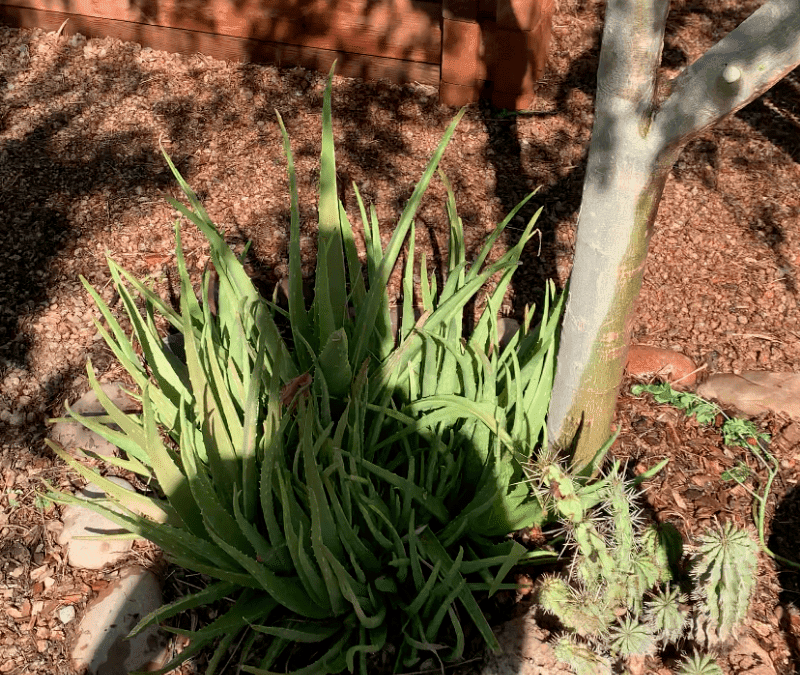
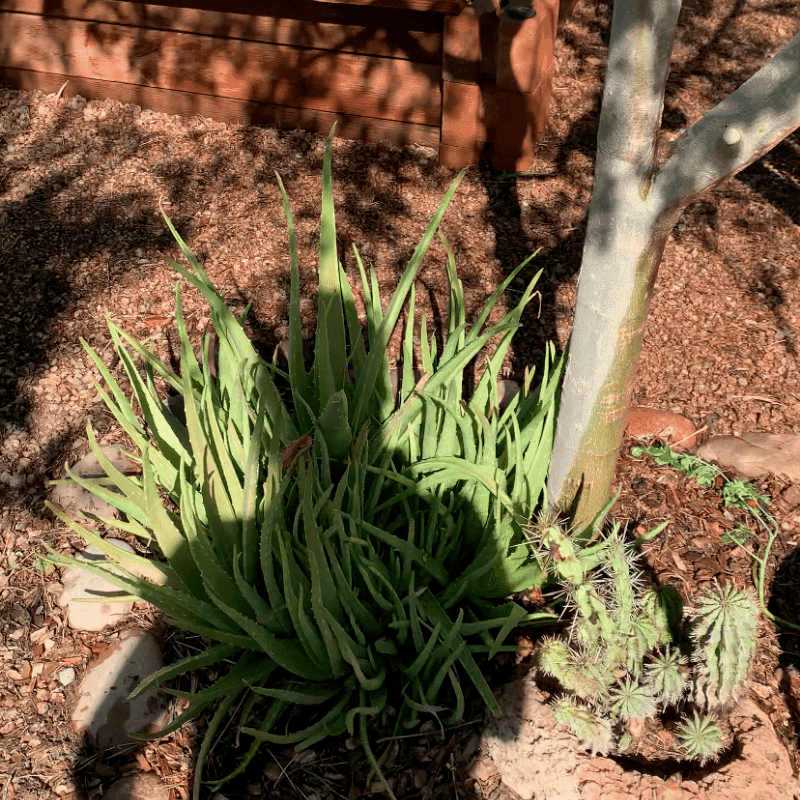
If your boundaries feel too tight, maybe you need to break out a little, or leave a group you've been part of, or tell someone you're going to do it your own way. I had succulents drying up and dying in their pots because they didn't have the space or resources to thrive. Here they are now.
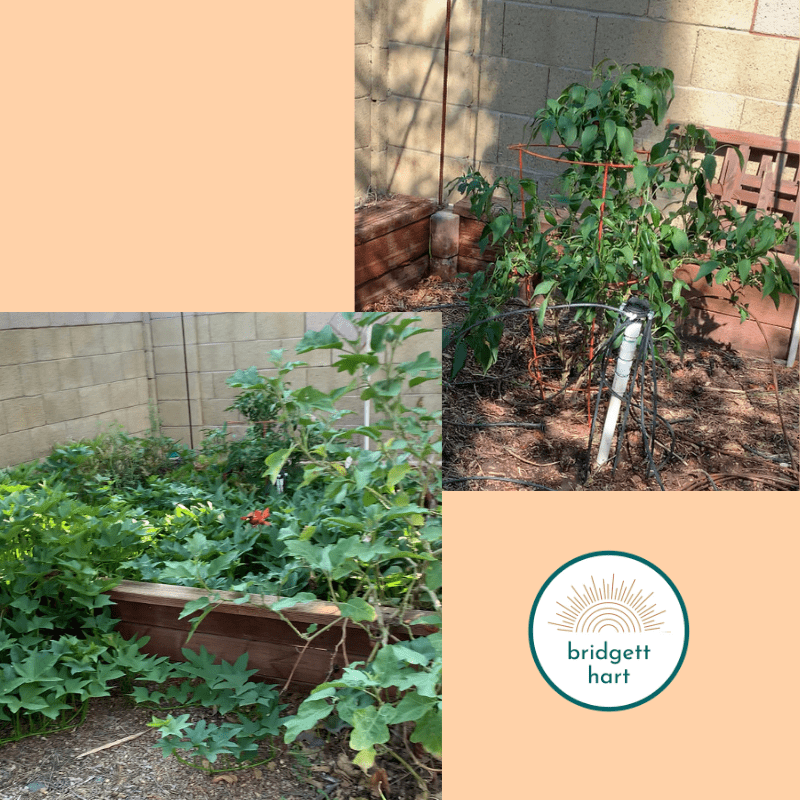
By contrast, I couldn't even see my jalapeno plant in the garden because the sweet potato vines had taken over everything. Turns out sweet potatoes next to tomatoes and eggplant is the perfect recipe for blight. I know that now, and some boundary changes had to happen.
If your boundaries are too loose, and you're feeling out there on your own, maybe you need to find your community, pull in support, and make sure you have good people around you to help maintain the boundaries you actually want.
You're Not Alone
If you're struggling with anxiety and negative thoughts, you are not alone. I've been there. I know what it's like, and I keep making it through. You can too. Seek all the help you deserve, which is every single kind of help available, and then some, and give yourself the grace to move through it one minute at a time.
Have you ever wondered how connecting with your inner spirit might help you manifest more in your life?
The connection you build with your inner spirit is the freeway to the life you actually want. Does that mean you can pray about it and get whatever you ask for? Of course not. But it does mean that as you learn to listen and learn from your inner spirit, you get in alignment with your most authentic self, and with the actual steps that turn your dreams into something real.
What Even Is "Spirit"?
We have a lot of names for the same idea across different societies: Jesus, God, Buddha, the Universe, Krishna, Jehovah. What you call it matters less than whether you take the time to connect.
My own background is Christianity. In that tradition, we believe we can get saved by praying and asking Jesus to live in our hearts. To me, that means Jesus lives inside me, which makes me capable of everything Jesus, living in me, is capable of. So what I'm describing here isn't new-agey, and it isn't anti-Christian. It's right in line with what the Bible has always said.
Get Intentional
Spirit is always there, but it won't push its way into your life. It won't force a particular path or force good choices on you. It's there, constantly sharing love and wisdom, but you have to pay attention to actually receive any of it.
Get intentional about wanting to connect. Think about how you've connected with Spirit in the past, how your ancestors connected. How do the people around you deepen their own relationship to it now? Just because you learned one way as a kid doesn't mean it's the only way, or the right way for you now. If it still fits, great. If it doesn't, that's okay too. Maybe it's ten minutes of meditation each morning, or a weekly trip to the mountains or the ocean to pray and write. There are countless ways to connect. Figure out which ones actually fit you, then make the adjustments, the plans, the space, to do it on purpose.
Meditation and rest, learning more about yourself, your ancestry, where you come from, all of this is crucial to building the kind of world where everyone is cared for and able to live fully. Getting our own internal work done is what makes it possible to have genuinely healthy, productive relationships with each other and with the planet, and right now, we're not doing a great job of either. The more intentional you get about what you want from Spirit, what you want to give it, and what communion with it actually looks like for you, the better this goes.
Get Quiet
I sometimes describe Spirit as the quietest voice in my head. It's the persistent whisper underneath all the other, louder voices trying to drown it out. Often it's telling me to do the hard thing. Sometimes it's shouting: stop and rest, the way it did before I ended up hospitalized for a week with diabetic ketoacidosis.
Meditation is one of my favorite ways to get quiet. I recommend the Calm app. But there are plenty of paths there: yoga, hiking, driving, gardening, working out, anything that quiets the mind enough for Spirit to actually be heard.
If you don't have any specific practices, rituals, or spiritual background at all, start here. Go into a quiet space and just be quiet. This isn't about praying or telling God what you want. It's not about throwing out requests. It's about shutting down, focusing on your breath, on the movement of blood through your body. If you know nothing else, you can learn this. Spirit comes to a quiet mind. And if your mind genuinely won't quiet down, therapy is a real and valid option too, not a failure of this practice.
Get Community
One of my favorite things about the divine is its duality. Truth can be false, false can be true, there's very little absolute truth beyond the fact that we are love, and we are loved. Your spiritual walk is deeply personal, and your relationship with God is yours alone. However. Your existence on this planet is not yours alone. It exists in relation to everything else here too. You're solely responsible for your own journey, and inextricably connected to everyone and everything around you.
One of the best ways to connect with your inner spirit is to spend time with people who share your values, people trying to produce the same kind of good energy. That might be a church, as long as it honors your authentic self, a monastery, a temple, a friend group, family. We're connected, and Spirit is stronger when we're together.
I've wondered before whether you have to go to church or formally meditate to hear Spirit. The answer is no. Spirit communicates with you at all times, in every way. The real skill is learning to see and hear the messages.
Whatever kind of spirituality or community works for you is fine, as long as it isn't a cult, nobody should be asking you to drink the Kool-Aid, or asking you to leave your family and friends behind. If it's genuinely helping you connect, and it isn't isolating you, it's good. A lot of people assume I dislike church because I left mine years ago. I love the church. I love people in churches, plenty of them, and I have real friends across a lot of different kinds of congregations. I just don't personally attend that type of church anymore, because it's a disconnect for me on my own spiritual path. That's okay. I have a different kind of community now, built around connecting to Spirit in the way that actually works for me.
I heard a good analogy recently, from Neale Donald Walsch's Conversations with God, an older book I still recommend. We tend to say Spirit inhabits our body. I've said it that way myself. But really, Spirit envelops the body. The spirit that is me surrounds my body; my body is part of how that spirit moves through the world, but the spirit itself is bigger than just this physical being. Once you think of it that way, you realize that if Spirit envelops you, then your spirit is also what connects with, bumps into, the spirits and energy of the people around you. Get in community with people trying to move in the same direction, because other energies are going to affect yours whether you like it or not, unless yours is strong enough to affect theirs instead. The more connected you get, the more depth you have access to, and the more your own energy is able to shift what's around it.
Being Intentional and Quiet Are the Training Ground
Being intentional and getting quiet are what train you to walk around talking with Spirit all day long, not just in dedicated moments.
I used to wonder why anyone would choose to become a monk or a nun. It seemed extreme. But once I understood what intentionality and quiet actually do for your ability to communicate with Spirit, and how good it feels to live at that level of connection regularly, I got it. Being present with the divine is its own kind of ecstasy. Choosing it as a full lifestyle makes sense.
That said, I'm still pretty connected to some of my more human desires too. Wild sex with my husband. Decadent vacations to tropical islands. Sue me, I'm human. I love you.
Recommended resources: Calm Conversations with God by Neale Donald Walsch
Question of the day: How do you connect to Spirit, and what do you call it?
Rest is necessary, and it's regenerative. Our bodies rejuvenate while we're at rest. That's why you feel so great on vacation. But rest shouldn't only happen on vacation. Can you imagine how your car would run if you only checked the oil and added gas once a year?
There's real danger in the fact that we do this to ourselves. The devastation is that we keep teaching it to our children too, that "working hard," "doing something important," and hustling from dawn until the middle of the night is what it means to be good.
The idea that hard work alone is the path to riches is a myth. The truth is, we're all connected, to each other and to this planet we share. We have enough resources to care for every human being on earth. The value you bring simply because you exist is already shared and real. You don't have to do anything else, ever, to be massively valuable. Your presence here is priceless. Everything beyond that is icing on an already good cake.
We treat rest like a luxury, but it's a necessity, and the only reason it looks like a luxury is that capitalism has spent its entire existence convincing us otherwise. Rest is a luxury for something that exists only as a cog in a wheel. Oil it up, keep it spinning. But you are not a cog. You are a unique, perfectly imperfect, priceless human being, and you deserve rest.
Where This Teaching Comes From
This is a teaching I've learned from, not one I invented. Tricia Hersey, founder of The Nap Ministry and author of the New York Times bestseller Rest Is Resistance: A Manifesto, built this framework specifically for Black women and Black people, out of Black liberation theology, somatics, and a direct historical reckoning with what capitalism and slavery did, and still do, to Black bodies specifically. Rest, in her work, is resistance to a system that was built on the theft of Black labor and Black rest in the first place. That context matters, and it's not mine to flatten into something generic.
It's also true, as Hersey herself teaches, that this message extends to all of us, white folks included. But I want to be honest about what that means for me specifically, as a white woman. In some real ways, white people have been resting too long. Politically. Comfortably. While other people did the work of showing up.
Look at the 2024 election. Roughly nine in ten Black women, some exit polls put it as high as 92%, voted for Harris. That's about as close to unified political labor as an entire demographic can get. And the outcome still wasn't what that labor deserved. That's not a reason to despair. It's a reason to notice who's been doing the work, and who hasn't been.
So: follow Black women. Learn from Black women. Rest, when you actually need it, the way Hersey teaches. But also, especially right now, especially politically, some of us have work to do. Rest and labor aren't opposites here; they're both part of the same practice of showing up honestly for what's ours to carry.
How to Actually Get the Rest You Need
Rest is the most foundational boundary you can set, because if you can't properly rest, you can't actually do whatever it is you're here to do. Here's how to build it, in four real steps.
1. Define what rest means to you. For me, rest definitely includes sleep, and it should. Physiologically, our bodies need it, we need deep sleep specifically, our body does real repair work in that state, and if you want to stay connected to your purpose, you need those hours. But define it beyond that too. Does it mean eight hours a night? Bed at 9pm, up at 5, 7, or 9? A day off every week instead of saving it all for one big vacation? Leaving work at 3pm and turning your phone off? A real vacation, once or twice or four times a year? Take a moment. Think about what your body needs, what your mind needs, what your spirit needs. Write it down.
2. Believe you deserve it. Your body needs rest whether you believe you deserve it or not, but you have to value it enough to actually make the decisions and sacrifices that protect it. If you can't believe it yet, fake it until you do. Give yourself the rest anyway, and let your brain catch up to believing you're allowed to have it.
3. Get your schedule together. Figure out what needs to change to protect the rest you defined in step one. That might mean cutting off work at a certain hour, getting kids to bed on a schedule that lets you actually wind down, telling your job you're not available past a certain time, or asking for time off. It might mean quitting a job that won't allow you to protect your own boundaries, or building something new instead. That's not easy, and nobody else can do it for you.
If it comes down to it, downsize. Move into a smaller life if that's what real rest requires, because a heart attack doesn't care how big your house is. It doesn't care that you were successful. Your family will still miss you, and whatever your purpose was will stop dead in its tracks either way. I'm not saying it's easy to let go of everything capitalism has told us we need. It isn't. It's genuinely hard to trust that you'll still be cared for once you stop over-functioning to earn it. But caring for yourself is one of the real ways the universe cares for all of us, together.
4. Don't try to go it alone. There's real help out there. I have a brain that clicks and clicks and doesn't stop easily, so I understand insomnia. A few things that help me: start with your environment. If the TV runs all day and night in your room, that might need to change, or at least get a hard cutoff time. The Calm app has good sleep meditations and sleep music, especially paired with a decent set of headphones. I use an inexpensive sleep aid from Costco some nights, and it works. There's no shame in using tools. We're not meant to be superhuman, and tools exist for a reason.
I also use a diffuser with essential oils, lavender especially, which is calming and genuinely aids sleep. And I use cannabis, CBD and THC, at night. If that's something you're considering, know your strains, since different ones have very different effects, and know your own dosage. Buy from a source that provides real, verifiable lab testing. There are a lot of people selling products that aren't what they claim to be.
Wrap Up
That's four steps to get more rest in your life, because rest is your birthright, and it's the most foundational boundary you can set. Once that boundary is in place, your mind, your body, and your spirit are actually ready to access the divinity that's already in you. There's a lot in there worth discovering. But you need your rest first, to actually get to it.
Recommended resources: The Nap Ministry, founded by Tricia Hersey Rest Is Resistance: A Manifesto by Tricia Hersey Calm
Question of the day: What does rest actually look like for you, and what's standing in the way of it right now?
To provide the best experiences, we use technologies like cookies to store and/or access device information. Consenting to these technologies will allow us to process data such as browsing behavior or unique IDs on this site. Not consenting or withdrawing consent, may adversely affect certain features and functions.
Functional
Always active
The technical storage or access is strictly necessary for the legitimate purpose of enabling the use of a specific service explicitly requested by the subscriber or user, or for the sole purpose of carrying out the transmission of a communication over an electronic communications network.
Preferences
The technical storage or access is necessary for the legitimate purpose of storing preferences that are not requested by the subscriber or user.
Statistics
The technical storage or access that is used exclusively for statistical purposes.The technical storage or access that is used exclusively for anonymous statistical purposes. Without a subpoena, voluntary compliance on the part of your Internet Service Provider, or additional records from a third party, information stored or retrieved for this purpose alone cannot usually be used to identify you.
Marketing
The technical storage or access is required to create user profiles to send advertising, or to track the user on a website or across several websites for similar marketing purposes.