There are reasons why I know how to have hope even in desperate times. One of those reasons is my boundaries.
I wasn't taught early how to have good boundaries for myself, but once I learned, it became much easier to know for sure what to do in chaotic or uncertain times.
The boundary in question is one I didn't even realize I had made at a young age. I knew what I felt in my body though, and on this detail, I simply trusted it, despite a mountain of "evidence" to the contrary.
Fifteen Years Old in North Idaho
See, when I was about 15 years old, I broke up with the last white guy I ever dated. I never so much as went to dinner or a movie with another white romantic interest.
Mind you, I lived in North Idaho. I definitely had a lot of white friends, of all genders. In fact, it was 98% white where I grew up 30 years ago, and it's still 98% white today. Just about all of my friends were white. I didn't date until college.
Suddenly, I was able to have close friends of all races and backgrounds. Even though I still lived in my hometown, scholarship programs attracted students from all over the world to the local college, and later the university I attended.
I found my people, and I settled in.
Except, they weren't my people.
The Harm I Did Before I Did the Work
See, I hadn't done my self-work yet, and I did a lot of harmful things along the way. Harmful to myself, and to the people I was in relationship with.
I appropriated culture. I believed lies that Black women hated me because I dated Black men. I repeatedly got into harmful relationships with damaged men because I was still damaged. I did all the things someone who is steeped in white supremacy culture might do that hurts people of color.
But I didn't change my boundary. I continued to seek healing and understanding for myself, and I continued to date men outside my race.
What the Boundary Cost, and What It Gave
I was called a "whigger" and a "mud-shark."
A boyfriend and I were once followed around in the mall by two men hurling slurs at us the whole time.
A Black friend was pulled over in my car virtually every time he drove it down our city's main street. I was never pulled over. Even when the tags were expired, and I had a cop behind me, clearly able to see it.
I lost business associates when I publicly supported Colin Kaepernick's peaceful protest.
I lost friends, family, and associates when I married my Black husband.
I gained friends, family, and associates when I married my Black husband.
I gained knowledge, wisdom, and understanding when I humbled myself, recognized my racism, and began working on undoing its harm in my community, like Black women taught me to do.
I learned how to love myself and others unconditionally, and that boundaries are part of that expression of love.
I learned what it feels like to be angry and afraid every day because the society you live in doesn't want you to be alive in the way that you are.
And I learned how to move past that into the unspeakable joy, and sometimes agony, of each moment of life.
Whose Oppressors Are You Raising?
Here we are as a nation, at a place where white women are suddenly having to face the reality that our human rights are not valued as highly as white men value their own. Period.
And as the brilliant @DesireeBStephens says, "White women, you are birthing and raising your own oppressors."
Somewhere along the line, you have followed the social norms that lead you to marry the men, birth their sons, and then raise those sons in the same patriarchal, white supremacist society that devalues you as a woman too, even though you're white, and you thought that made you special.
You've been trained to believe that Black women represent the worst of what society has to offer, and in fact, you've missed out on the fact that Black woman is the best divinity has to offer. And so are you. Turns out, one doesn't negate the other.
What other lies do you believe because a racist, patriarchal, capitalist society wants you to believe them?
Trust Her
Your body knows the truth, and as you begin to look in the mirror in all the ways I'm discussing, you'll be able to hear her so much more clearly.
Trust her, and do what she says, and you'll be on your way to having hope even in the most dire of circumstances.
Keep in mind though, this isn't about a destination. It's a journey, and the journey is about this moment right now. Take it one small step at a time, and just keep moving in the direction of the visions you see. You are perfect where you are, but as you know better, you'll be able to do even better.
Talk soon. I love you.
Question of the day: How do your boundaries feel in your body?
In order to have hope in desperate times, we have to start with taking a good look in the mirror. Next time you're feeling hopeless, think about the boundaries you have in place in your life. Are they hurting you, or helping you?
Boundaries as Path Markers
I've talked before about boundaries and how crucial they are to living our best life. That's not only because of how it benefits our mental health, but also because it helps guide and direct our life.
Think about a pathway through the woods. If there are no clear boundaries, it might be easy to get lost. But with a well-marked path, you feel more secure, right?
Boundaries act like those path markers in our lives and relationships. They help us determine what's off-course and how to get to our goals. Really, they just help us make sure we're going the way we want to go.
The fun, and sometimes scary, part is we don't always know what all our boundaries should be, or where we should place them now or in the future. Sometimes parts of our path are through areas where no one has gone before and laid out where the pathway is. We have to decide on our own.
Sometimes we worry that a boundary placed now will be a big obstacle for us later. And sometimes they will be.
Your Body Already Knows
But I have a secret for you. There's a great way to decide whether a boundary is right for you or not, in any given moment. You have an internal system that helps you figure it out.
I won't go into all the science behind why this works right now, but in a nutshell, your body has the capacity to tell you everything you need to know about a boundary. The key is to learn to hear it, and then to trust it.
Some of us call it our gut instinct, or have other ways of describing how our body speaks to us. But when I'm talking about boundaries, I want you to take what I'm saying very literally.
The Mirror Exercise for Boundaries
As part of the exercise of looking in the mirror, think about how the boundaries you have in your life make your body feel.
When you think about the different restrictions and lines you won't cross, how does your body feel? Does it feel free and expansive when you think of it, or binding and restrictive?
For example, a boundary of no work calls after 6:30pm could have both the expansive feeling of being free in the evenings to spend uninterrupted time with your kids, or it could feel restrictive because so much business is being done by your competitors during that time. Neither is good or bad. They are merely different.
My point is that only you really know what the right boundaries are for you, and your body has the power to tell you about it if you listen closely.
So evaluate your boundaries while you're in the mirror, and ask yourself: how does my body feel about this boundary? The more closely you listen to your body's answers, the more aligned your life will get with your purpose, and the more hope you'll be able to access when times get tough.
My next post is about a boundary I put in place in my life, and how sometimes a boundary can put a big obstacle in your way, and thank goodness it does.
Talk soon. I love you.
Question of the day: How do your boundaries feel in your body?
Sometimes, our anxiety and negative thoughts come from garbage boundaries.
Self-Love Starts With Boundaries
Self-love is a giant topic. In The Hart Habits, the framework I built to help my coaching and consulting clients move through massive transitions with alignment and love at the core, I break it into four areas: Strengths, Shadow, Spirit, and Boundaries. This post is about the first of those.
Positive vs. Negative Boundaries
There's always a yin and yang to everything, a good and bad, a shadow side and a bright side. Boundaries are no exception.
Boundaries can keep us tight and small, and can choke the life out of us if they're too tight or too close. On the other hand, when our boundaries give us the right amount of space to flourish, keeping them clear can be the key to honoring ourselves and giving ourselves what we need to grow.
We're All Energy
When we make boundaries, they help define us. Think about a ceramic vase. If it didn't have walls, it wouldn't hold or pour liquid. It needs walls to be usable. You're the same.
I believe we're all energy. The first law of thermodynamics, also known as the law of conservation of energy, states that energy can neither be created nor destroyed, only transferred or changed from one form to another.
We're all connected, across all space and all time. We're kind of like a lava lamp on this earth, all inside the same lamp, but our blobs separate into different shapes and sizes. We look different, but we're made of the same stuff. We're all manifestations of God, but we each get to inhabit our own vessel, our body, our life, this time around.
How Boundaries Define You
Our boundaries help define who we are in this world. How do I walk through it? How do I interact with the people around me? What matters to me, and how are my priorities structuring my life?
If you feel like your boundaries are being crossed by others, that might have something to do with how you're prioritizing yourself, because you prioritize what's important to you, whether you're conscious of it or not. If you don't know what's important to you specifically, other people are more than happy to lend you their cares and hand you their priorities to carry as your own. Be careful not to let that happen. Your boundaries should be yours alone.
How Boundaries Direct You
Your boundaries also help inform where you're going, because you get more of whatever you put your energy toward. Think about where you're trying to go, and how your boundaries can help channel your energy there. We've all made time for studying, or skipped an event because we had to work.
One of my most important boundaries is rest. I value it, and I understand the power it has to help me bring my full self to each moment, so I make sure to go to bed on time every night so I can wake up refreshed. I even take a mild sleeping pill or a cannabis tincture at night, to give my body the rest it needs. It took a long time for me to embrace those tools, but once I prioritized my needs over societal stigma, I found massive benefits in listening to my body first.
When I'm short on sleep, I find ways to schedule a nap during the day. I set my alarm, put down my phone, and close my eyes. Sometimes I sleep, sometimes I just rest. I fought this practice tooth and nail for much of my life, because of the hustle culture of American capitalism. I really believed that if I was going to make it in this economy as a woman, I could never rest or let my guard down. Instead, rest has become a way for me to fight the power and reclaim my divinity. Divinity is a much better feeling to cultivate than hustle.
What I create when I'm well-rested is phenomenally superior to what I produce from exhaustion.
How to Set Boundaries That Are Right for You
It can be difficult to know where our boundaries should be. Should we give money to family? Should we let friends move in? Should we keep working a job that underpays, undervalues, and overworks us? Should we say no to Mom?
Honestly, there's no right or wrong answer. Only you know what works for your life. I can tell you what I think, other people can tell you what they think, but none of it matters, because you're the only one existing in your body, in your life.
So the best way to know whether your boundaries are where they need to be is to evaluate how they feel. How does it feel when they're in place and honored? How does it feel when they're not?
Pay attention to those feelings. Your body and mind are powerful, and they'll communicate clearly if you listen. As you consciously make changes and tune into your body, you'll feel resistance to what you're moving away from, and pull toward what you're moving toward. Does it make you feel free? Liberated? Oppressed? Angry? Resentful? Ask what the boundary is actually doing for you, and let that tell you whether it needs to change.
Examples From My Own Garden
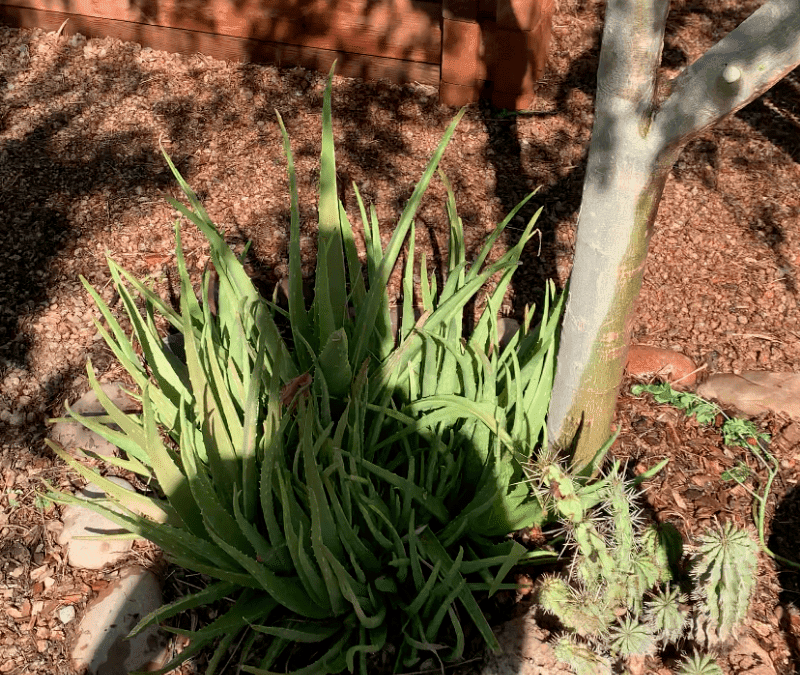
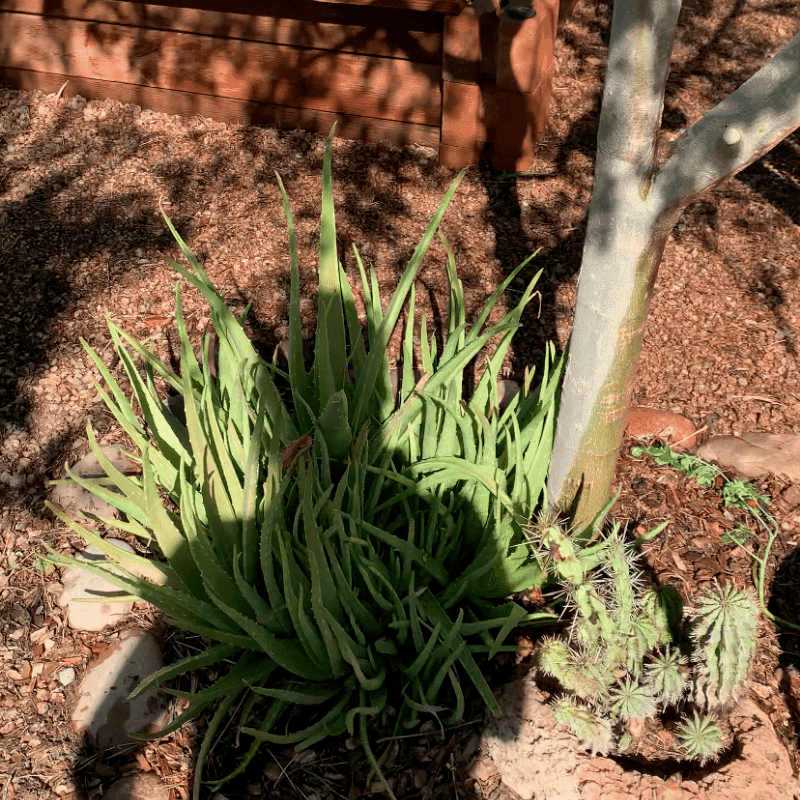
If your boundaries feel too tight, maybe you need to break out a little, or leave a group you've been part of, or tell someone you're going to do it your own way. I had succulents drying up and dying in their pots because they didn't have the space or resources to thrive. Here they are now.
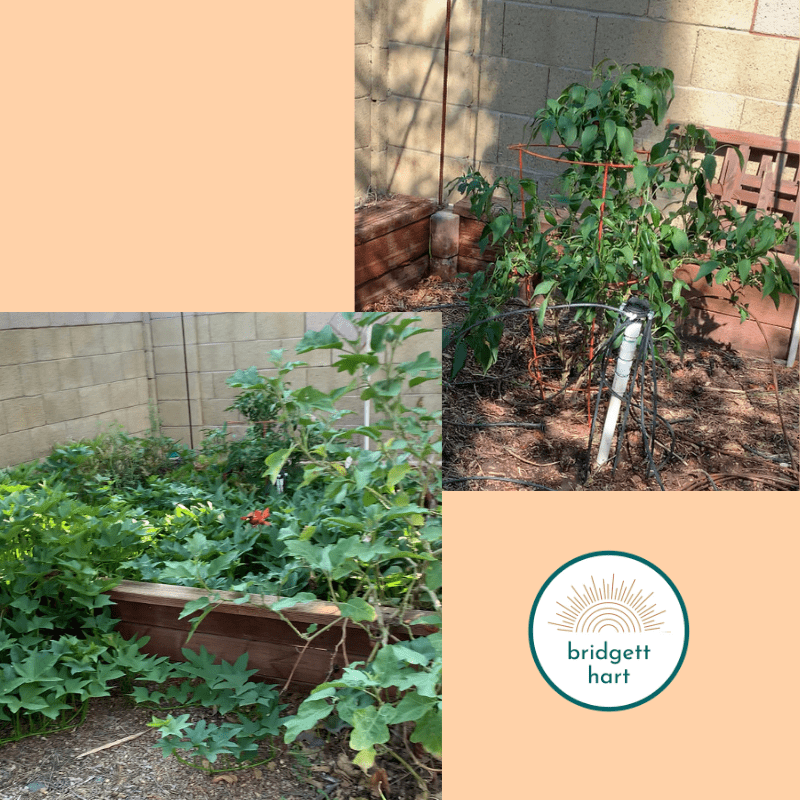
By contrast, I couldn't even see my jalapeno plant in the garden because the sweet potato vines had taken over everything. Turns out sweet potatoes next to tomatoes and eggplant is the perfect recipe for blight. I know that now, and some boundary changes had to happen.
If your boundaries are too loose, and you're feeling out there on your own, maybe you need to find your community, pull in support, and make sure you have good people around you to help maintain the boundaries you actually want.
You're Not Alone
If you're struggling with anxiety and negative thoughts, you are not alone. I've been there. I know what it's like, and I keep making it through. You can too. Seek all the help you deserve, which is every single kind of help available, and then some, and give yourself the grace to move through it one minute at a time.
Rest is necessary, and it's regenerative. Our bodies rejuvenate while we're at rest. That's why you feel so great on vacation. But rest shouldn't only happen on vacation. Can you imagine how your car would run if you only checked the oil and added gas once a year?
There's real danger in the fact that we do this to ourselves. The devastation is that we keep teaching it to our children too, that "working hard," "doing something important," and hustling from dawn until the middle of the night is what it means to be good.
The idea that hard work alone is the path to riches is a myth. The truth is, we're all connected, to each other and to this planet we share. We have enough resources to care for every human being on earth. The value you bring simply because you exist is already shared and real. You don't have to do anything else, ever, to be massively valuable. Your presence here is priceless. Everything beyond that is icing on an already good cake.
We treat rest like a luxury, but it's a necessity, and the only reason it looks like a luxury is that capitalism has spent its entire existence convincing us otherwise. Rest is a luxury for something that exists only as a cog in a wheel. Oil it up, keep it spinning. But you are not a cog. You are a unique, perfectly imperfect, priceless human being, and you deserve rest.
Where This Teaching Comes From
This is a teaching I've learned from, not one I invented. Tricia Hersey, founder of The Nap Ministry and author of the New York Times bestseller Rest Is Resistance: A Manifesto, built this framework specifically for Black women and Black people, out of Black liberation theology, somatics, and a direct historical reckoning with what capitalism and slavery did, and still do, to Black bodies specifically. Rest, in her work, is resistance to a system that was built on the theft of Black labor and Black rest in the first place. That context matters, and it's not mine to flatten into something generic.
It's also true, as Hersey herself teaches, that this message extends to all of us, white folks included. But I want to be honest about what that means for me specifically, as a white woman. In some real ways, white people have been resting too long. Politically. Comfortably. While other people did the work of showing up.
Look at the 2024 election. Roughly nine in ten Black women, some exit polls put it as high as 92%, voted for Harris. That's about as close to unified political labor as an entire demographic can get. And the outcome still wasn't what that labor deserved. That's not a reason to despair. It's a reason to notice who's been doing the work, and who hasn't been.
So: follow Black women. Learn from Black women. Rest, when you actually need it, the way Hersey teaches. But also, especially right now, especially politically, some of us have work to do. Rest and labor aren't opposites here; they're both part of the same practice of showing up honestly for what's ours to carry.
How to Actually Get the Rest You Need
Rest is the most foundational boundary you can set, because if you can't properly rest, you can't actually do whatever it is you're here to do. Here's how to build it, in four real steps.
1. Define what rest means to you. For me, rest definitely includes sleep, and it should. Physiologically, our bodies need it, we need deep sleep specifically, our body does real repair work in that state, and if you want to stay connected to your purpose, you need those hours. But define it beyond that too. Does it mean eight hours a night? Bed at 9pm, up at 5, 7, or 9? A day off every week instead of saving it all for one big vacation? Leaving work at 3pm and turning your phone off? A real vacation, once or twice or four times a year? Take a moment. Think about what your body needs, what your mind needs, what your spirit needs. Write it down.
2. Believe you deserve it. Your body needs rest whether you believe you deserve it or not, but you have to value it enough to actually make the decisions and sacrifices that protect it. If you can't believe it yet, fake it until you do. Give yourself the rest anyway, and let your brain catch up to believing you're allowed to have it.
3. Get your schedule together. Figure out what needs to change to protect the rest you defined in step one. That might mean cutting off work at a certain hour, getting kids to bed on a schedule that lets you actually wind down, telling your job you're not available past a certain time, or asking for time off. It might mean quitting a job that won't allow you to protect your own boundaries, or building something new instead. That's not easy, and nobody else can do it for you.
If it comes down to it, downsize. Move into a smaller life if that's what real rest requires, because a heart attack doesn't care how big your house is. It doesn't care that you were successful. Your family will still miss you, and whatever your purpose was will stop dead in its tracks either way. I'm not saying it's easy to let go of everything capitalism has told us we need. It isn't. It's genuinely hard to trust that you'll still be cared for once you stop over-functioning to earn it. But caring for yourself is one of the real ways the universe cares for all of us, together.
4. Don't try to go it alone. There's real help out there. I have a brain that clicks and clicks and doesn't stop easily, so I understand insomnia. A few things that help me: start with your environment. If the TV runs all day and night in your room, that might need to change, or at least get a hard cutoff time. The Calm app has good sleep meditations and sleep music, especially paired with a decent set of headphones. I use an inexpensive sleep aid from Costco some nights, and it works. There's no shame in using tools. We're not meant to be superhuman, and tools exist for a reason.
I also use a diffuser with essential oils, lavender especially, which is calming and genuinely aids sleep. And I use cannabis, CBD and THC, at night. If that's something you're considering, know your strains, since different ones have very different effects, and know your own dosage. Buy from a source that provides real, verifiable lab testing. There are a lot of people selling products that aren't what they claim to be.
Wrap Up
That's four steps to get more rest in your life, because rest is your birthright, and it's the most foundational boundary you can set. Once that boundary is in place, your mind, your body, and your spirit are actually ready to access the divinity that's already in you. There's a lot in there worth discovering. But you need your rest first, to actually get to it.
Recommended resources: The Nap Ministry, founded by Tricia Hersey Rest Is Resistance: A Manifesto by Tricia Hersey Calm
Question of the day: What does rest actually look like for you, and what's standing in the way of it right now?
Manage Consent
To provide the best experiences, we use technologies like cookies to store and/or access device information. Consenting to these technologies will allow us to process data such as browsing behavior or unique IDs on this site. Not consenting or withdrawing consent, may adversely affect certain features and functions.
Functional
Always active
The technical storage or access is strictly necessary for the legitimate purpose of enabling the use of a specific service explicitly requested by the subscriber or user, or for the sole purpose of carrying out the transmission of a communication over an electronic communications network.
Preferences
The technical storage or access is necessary for the legitimate purpose of storing preferences that are not requested by the subscriber or user.
Statistics
The technical storage or access that is used exclusively for statistical purposes.The technical storage or access that is used exclusively for anonymous statistical purposes. Without a subpoena, voluntary compliance on the part of your Internet Service Provider, or additional records from a third party, information stored or retrieved for this purpose alone cannot usually be used to identify you.
Marketing
The technical storage or access is required to create user profiles to send advertising, or to track the user on a website or across several websites for similar marketing purposes.