Sometimes, our anxiety and negative thoughts are Spirit trying to connect with us, trying to send us a message.
This is something I struggled with for years, so it's a topic I know intimately.
The Last Piece of Self-Love
The past few posts have been about self-love, and how loving ourselves well keeps anxiety and negative thinking from getting the best of us. This is the last piece: bringing our full selves, including our connection to Spirit, into the world we live in.
Note: If you're currently struggling with suicidal thoughts, please reach out to the 988 Suicide & Crisis Lifeline. You can call or text 988 anytime. You deserve support, right now, exactly as you are.
What Happened to Me at the End of 2019
I suddenly began experiencing a lot of anxiety and negative thinking, overwhelming thoughts of death. It felt out of body, because it wasn't something I was accustomed to.
I was struggling with suicidal thoughts, and a total loss of hope, and I didn't understand where it came from. Fortunately, I tapped into my network, my resources, and the system I use to stay connected, and it worked. I got through.
What I figured out later was that Spirit was trying to send me a message. A few months after that, a pandemic hit the world, and it turned out I'd been feeling something related to that all along.
What I Mean By "Spirit"
I'm not saying you're a blossoming mystic like me, or that you have some message you need to share with the world. What I am saying is that here we are on this earth, and we are energy.
The law of thermodynamics tells us energy can't be created or destroyed, only changed in form. Everything on earth and in the universe we know of is made of atoms, made of subatomic particles moving at different frequencies. We're all made of the same energetic matter. From a scientific standpoint, we are energy, and we emit and interact with measurable frequencies.
I like to compare our existence here to a lava lamp. The lamp is God, or the universe, and we're all part of it. Some of us are the water the blobs float through, some of us are the blobs. Every time a blob floats up, it breaks into different sizes, sinks, comes up again, breaks apart again, over and over. The blobs change form, size, how they look, how they move, but they're all made of the same stuff, inside the same lamp.
We may die and be born, but really, our energy has just changed form. Some believe we become dirt, which feeds plants, which feeds nature, which feeds humanity. Others believe we take on new human or other forms. I'm not trying to settle that debate, but thinking about our time here this way can change how we approach some things.
I know this might challenge some theistic beliefs, and that's not my intention. My intention is to open up the possibility that God is everywhere around us, and in and through us. As part of God in nature, you're an integral piece of the whole, and so is everyone around you, and so is all the nature around you. The Spirit wants to be connected to you, but really, the Spirit already is connected to you. There's no way around that. What we're actually working on is becoming open enough to hear it.
For My Atheist Friends
I get that this might be tough for friends in the atheist community, and I'm sorry if it is. My background is Christianity, that's the language and bias I come from. I honor and respect your own way of engaging with this, and I'll keep working to find language that fits better for you too. Ultimately, the point is: I'm connected to you, you're connected to me, we're part of nature and earth together, and we all matter.
Get Quiet
The first thing to do is get quiet. Just get quiet.
This is genuinely hard in today's world. With all the devastating news and scary things happening, quiet is hard to come by, but it's the first and most important part of connecting with Spirit.
I'm a fan of using tools to help with this, so I recommend the Calm app or Brain.fm, both offer guided meditations and frequencies that can help you get into a relaxed, meditative state. You might also try closing doors, taking alone time, and literally just being quiet. If sitting still with your own mind is hard, lean on a guided tool instead.
Other ways to get quiet: nature walks, a yoga class, working out, a prayer closet, meditation, a silent retreat.
Get Connected
Once you're quiet, you can get connected. This part is intentional and personal. It might mean researching the historical roots of your lineage, your ancestry, your family of origin, or your current community, especially around religion or spiritual connection. Ask yourself: how have your people connected to Spirit in the past?
If you find you're enhanced by Spirit through being with other people, do that. Find your people. Reach out. Spend time with those who lift you up and encourage your best self. That might mean getting involved in a local church or temple, a business group, a gardening group, a gaming group, anything that matters to you and connects you to others of like mind.
One of my mentors in this space is Isha Cogburn, of the Epiphany Institute. She's the person who first pushed me to actually write down and name what would become the Hart Habits, and her own work on spiritual connection has shaped a lot of how I think about this.
Spirit Exists Because You Exist
If you want to connect with Spirit, get quiet, then get connected to what's already around you naturally. Your sphere of influence is there for a reason.
It's simplistic to say connection is just get quiet, get connected. But the real point is that you're already part of the divine of this whole planet. Spirit exists because you exist.
All you need to do is tie into the network Spirit has already built for you, your friends, family, neighbors, coworkers, church, garden group, bowling team, running team, whatever it is. They're there on purpose, as your support and strength for the hard stuff.
And Spirit doesn't only exist in people. It's in every part of the nature you move through too. Spirit is your favorite hiking spot, your garden, the feral kittens born in your backyard, the octopus you met on a scuba trip, the car accident you survived, the devastating loss you carried, the trauma you went through, and every emotion and desire you felt along the way.
I hope you're finding your own way to intentionally get quiet and get connected to the Spirit that's already around you. As you start listening more closely, I'd love to hear what kind of messages you start noticing. It's funny to me when mine come from a commercial I've heard a thousand times, or a billboard I'd never noticed before. I can't wait to hear where you find yours.
Sometimes, our anxiety and negative thoughts result from not addressing our shadow self, or doing our inner child work.
The Third Part of Self-Love
I've been talking about prioritizing ourselves and loving ourselves well. First, boundaries: keeping them where they need to be, in a place that gives us success without keeping us too tied down. Then, strengths: knowing and using them in our day-to-day lives, so we can feel real fulfillment and see a real decrease in anxiety and negative thinking.
This week is tougher: shadow work, sometimes called inner child work.
I Didn't Think This Applied to Me
I remember the first time I heard about inner child work and shadow work. I thought, I'm not sure that applies to me. My life's been pretty easy. I haven't gone through that much. I think I'm fine. I don't have a lot of dark sides, I'm just nice and bubbly and happy.
I was wrong. So, so wrong.
Why We All Have a Shadow Self
We all have a shadow side, and we all have an inner child. Every one of us was a child once, and every one of us has suffered some kind of trauma. It could be neglect or abuse, or it could be something less dramatic. There are countless kinds of trauma that might've happened to you, and that have happened to me.
As adults, we can look back on those events with new eyes, new understanding, and a new ability to process them. But when things happen to us as children, we process them as a child would, and children are very focused on themselves. The long-term result is a lack of love for self. We blame ourselves for what we went through, and we keep blaming ourselves as we grow older, often subconsciously, the whole time.
The solution is to dig into your shadow self and do some inner child work. I'll give you a simple tool that's helped me start this process. As always, I recommend therapy as an excellent container for walking through what you experienced as a child.
The Photo Exercise
When I'm working with a client and I see there's inner child work to be done, I typically recommend this to start:
Find a photo of yourself at an age where you felt innocent, beautiful, and wonderful, whatever age that was for you.
Keep that photo in front of you as much as possible, for at least three days. Make it your screensaver. Put it on your steering wheel or your desk. Somewhere you'll see it often.
As you look at it, start talking to little you. Ask how they're doing. Tell them what they have to look forward to. Assure them of who they are, and how wonderful and phenomenal they are. You'll find your own words when you look at your own photo.
Continue the conversation for the rest of your life.
Why It Works
At the root of this exercise is the chance to take out your inner child, address the traumas that baby girl or baby boy went through, and reparent the child within you with love, compassion, acceptance, and communication, whatever might have been missing the first time around.
Embrace your shadow self. Embrace your inner child. Embrace, ultimately, the traumas you've gone through. They were terrible. That's true. You were hurt, and you didn't deserve it, not at all. That was probably the result of someone else's wrong actions. But you were hurt, and you had the strength to survive. You came through it. You survived it, and hopefully even thrived despite it. Now you're a successful grown-up.
You have the opportunity to give young you, still inside of you, the security you've built for yourself now.
I know it sounds a little wild. It does work.
So do your shadow work. Get to know the traumas. Open your eyes to them. Flip on the lights. Talk about it. Work it out. Get a therapist. Do all the things, so you can reparent that inner child and get to a fuller place in the here and now.
It's not about the destination. It's about the journey. Enjoy it.
Sometimes, our anxiety and negative thoughts are a result of not understanding our strengths.
The Second Part of Self-Love
In The Hart Habits, I break self-love into four parts. Last post was about the first, boundaries. Today's is about the second: knowing and embracing your natural strengths.
I Thought I Knew My Strengths
When I say strengths, what does that make you think?
I always thought I knew what mine were. I was gregarious, outgoing, and competent in a lot of situations, so I assumed my strengths were related to leadership, spreadsheets, scheduling, things like that.
Then I found the Clifton StrengthsFinder.
What the Clifton StrengthsFinder Actually Shows You
The CliftonStrengths assessment has now been taken by over 34 million people. Don Clifton developed it while serving as chairman of Gallup, the organization behind the worldwide Gallup Poll that's been collected since 1934. His research on human potential reached a massive audience through this tool, and the results are a goldmine.
I encourage you to take the hour-long assessment. You can purchase the book and get the evaluation for free, or purchase the assessment alone through Gallup's site.
Over a decade ago, this process taught me that my strengths are: activator, futuristic, relator, connectedness, and learner. I've used them ever since to build my coaching and consulting work, and The Hart Habits itself.
Why This Matters for Anxiety
When we know and work in our strengths, we get a lot more opportunity to feel fulfilled, and to feel like the contribution we're making is high value for the effort. You deserve to be valued for what you bring to the table. You're awesome.
So if you haven't done this before, today's the day. Take a moment to figure out what your strengths actually are. What helps you bring your best to the table?
If you aren't using your strengths regularly in your day-to-day life, that could be contributing to your anxiety and negative thinking. If you're not great at what you're spending your time doing, it's hard to focus on what's great about you.
But trust me: everyone has specific, unique strengths. There are no right or wrong ones. The CliftonStrengths assessment identifies 34 core strengths, and knowing your top five can significantly shift how you value yourself. Getting the chance to work in them, or build a business around them, is one of the real ways to create the life you want.
Recommended resources: The Gallup CliftonStrengths Finder Strengths Finder 2.0 by Tom Rath Body of Work by Pamela Slim The Widest Net by Pamela Slim Myers-Briggs Type Indicator 16Personalities (free MBTI alternative) High5 Test BetterHelp Online Therapy Calm
Question of the day: What are your strengths? Do you get to use them every day?
Sometimes, our anxiety and negative thoughts come from garbage boundaries.
Self-Love Starts With Boundaries
Self-love is a giant topic. In The Hart Habits, the framework I built to help my coaching and consulting clients move through massive transitions with alignment and love at the core, I break it into four areas: Strengths, Shadow, Spirit, and Boundaries. This post is about the first of those.
Positive vs. Negative Boundaries
There's always a yin and yang to everything, a good and bad, a shadow side and a bright side. Boundaries are no exception.
Boundaries can keep us tight and small, and can choke the life out of us if they're too tight or too close. On the other hand, when our boundaries give us the right amount of space to flourish, keeping them clear can be the key to honoring ourselves and giving ourselves what we need to grow.
We're All Energy
When we make boundaries, they help define us. Think about a ceramic vase. If it didn't have walls, it wouldn't hold or pour liquid. It needs walls to be usable. You're the same.
I believe we're all energy. The first law of thermodynamics, also known as the law of conservation of energy, states that energy can neither be created nor destroyed, only transferred or changed from one form to another.
We're all connected, across all space and all time. We're kind of like a lava lamp on this earth, all inside the same lamp, but our blobs separate into different shapes and sizes. We look different, but we're made of the same stuff. We're all manifestations of God, but we each get to inhabit our own vessel, our body, our life, this time around.
How Boundaries Define You
Our boundaries help define who we are in this world. How do I walk through it? How do I interact with the people around me? What matters to me, and how are my priorities structuring my life?
If you feel like your boundaries are being crossed by others, that might have something to do with how you're prioritizing yourself, because you prioritize what's important to you, whether you're conscious of it or not. If you don't know what's important to you specifically, other people are more than happy to lend you their cares and hand you their priorities to carry as your own. Be careful not to let that happen. Your boundaries should be yours alone.
How Boundaries Direct You
Your boundaries also help inform where you're going, because you get more of whatever you put your energy toward. Think about where you're trying to go, and how your boundaries can help channel your energy there. We've all made time for studying, or skipped an event because we had to work.
One of my most important boundaries is rest. I value it, and I understand the power it has to help me bring my full self to each moment, so I make sure to go to bed on time every night so I can wake up refreshed. I even take a mild sleeping pill or a cannabis tincture at night, to give my body the rest it needs. It took a long time for me to embrace those tools, but once I prioritized my needs over societal stigma, I found massive benefits in listening to my body first.
When I'm short on sleep, I find ways to schedule a nap during the day. I set my alarm, put down my phone, and close my eyes. Sometimes I sleep, sometimes I just rest. I fought this practice tooth and nail for much of my life, because of the hustle culture of American capitalism. I really believed that if I was going to make it in this economy as a woman, I could never rest or let my guard down. Instead, rest has become a way for me to fight the power and reclaim my divinity. Divinity is a much better feeling to cultivate than hustle.
What I create when I'm well-rested is phenomenally superior to what I produce from exhaustion.
How to Set Boundaries That Are Right for You
It can be difficult to know where our boundaries should be. Should we give money to family? Should we let friends move in? Should we keep working a job that underpays, undervalues, and overworks us? Should we say no to Mom?
Honestly, there's no right or wrong answer. Only you know what works for your life. I can tell you what I think, other people can tell you what they think, but none of it matters, because you're the only one existing in your body, in your life.
So the best way to know whether your boundaries are where they need to be is to evaluate how they feel. How does it feel when they're in place and honored? How does it feel when they're not?
Pay attention to those feelings. Your body and mind are powerful, and they'll communicate clearly if you listen. As you consciously make changes and tune into your body, you'll feel resistance to what you're moving away from, and pull toward what you're moving toward. Does it make you feel free? Liberated? Oppressed? Angry? Resentful? Ask what the boundary is actually doing for you, and let that tell you whether it needs to change.
Examples From My Own Garden
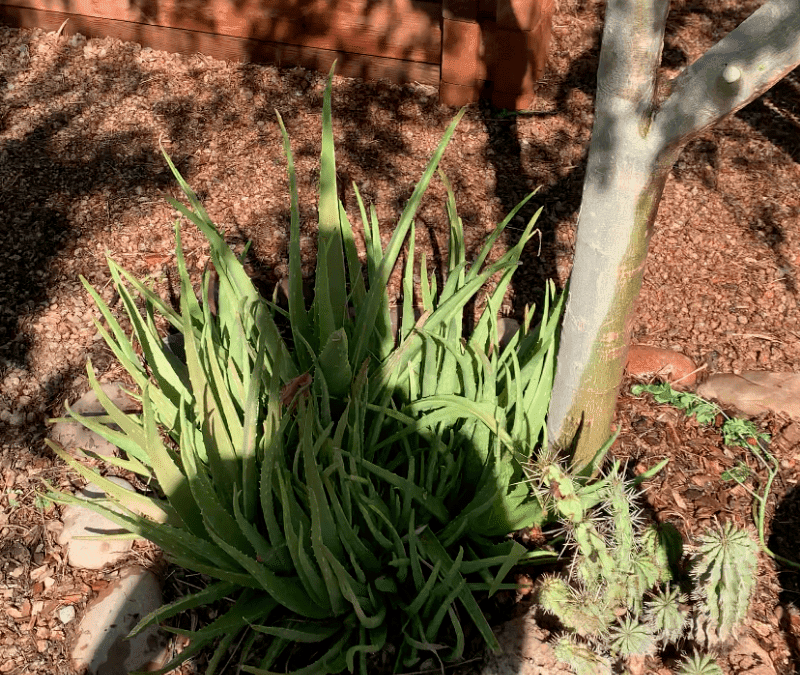
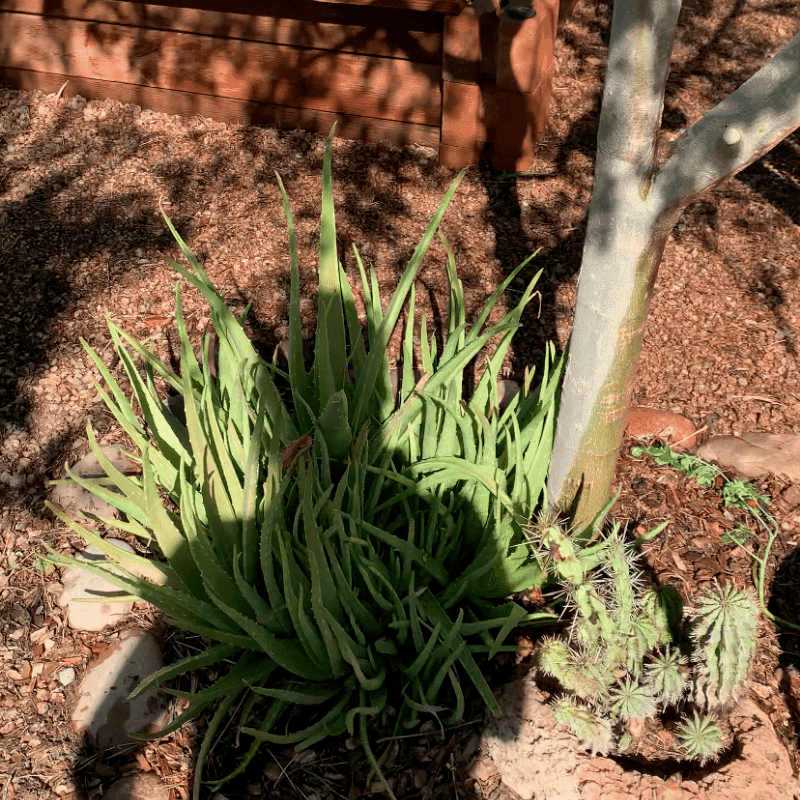
If your boundaries feel too tight, maybe you need to break out a little, or leave a group you've been part of, or tell someone you're going to do it your own way. I had succulents drying up and dying in their pots because they didn't have the space or resources to thrive. Here they are now.
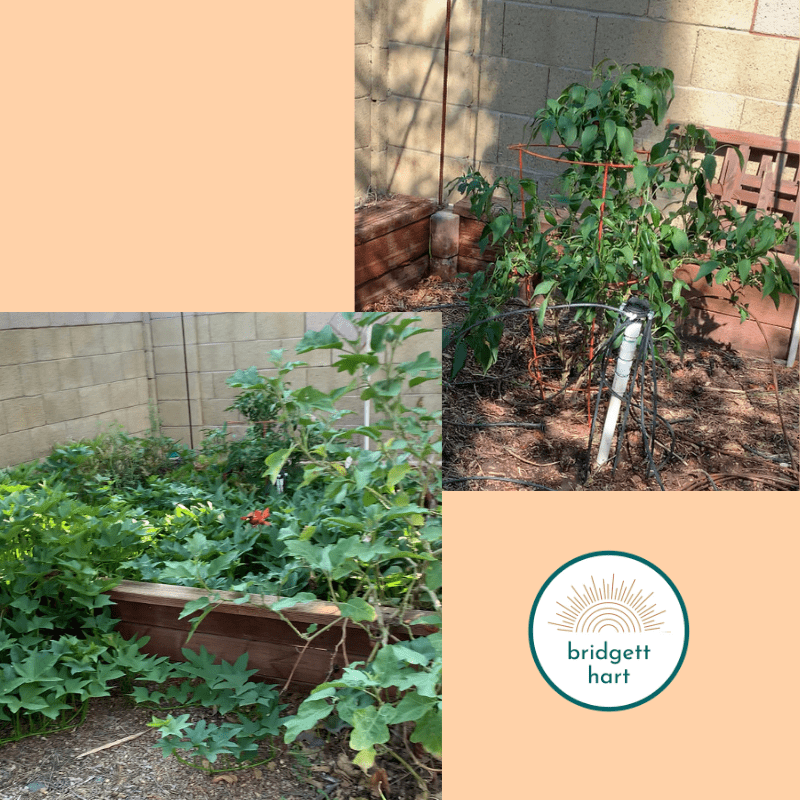
By contrast, I couldn't even see my jalapeno plant in the garden because the sweet potato vines had taken over everything. Turns out sweet potatoes next to tomatoes and eggplant is the perfect recipe for blight. I know that now, and some boundary changes had to happen.
If your boundaries are too loose, and you're feeling out there on your own, maybe you need to find your community, pull in support, and make sure you have good people around you to help maintain the boundaries you actually want.
You're Not Alone
If you're struggling with anxiety and negative thoughts, you are not alone. I've been there. I know what it's like, and I keep making it through. You can too. Seek all the help you deserve, which is every single kind of help available, and then some, and give yourself the grace to move through it one minute at a time.
Your brain has a filter, and once you understand how it works, you can change what it lets in.
Your Brain's Thermostat
Science tells us the brain is a primary player in anxious thinking. Here's a metaphor my husband will appreciate: your brain works like the A/C thermostat in your home.
We have a bundle of nerves called the Reticular Activating System, or RAS. The RAS operates like a thermostat for your brain. It reads the temperature around it, compares that to the temperature the homeowner, your amygdala and frontal lobe, has told it to achieve, and turns on or off to make the actual temperature match the desired one. It decides whether that means heating, cooling, fan only, or off, moment to moment.
According to an NPR interview with behavioral and data scientist Pragya Agarwal, the human brain can process 11 million bits of information every second. But our conscious minds can handle only 40 to 50 bits a second.
How does the conscious mind decide what to pull in? Enter the RAS. It sorts through those 11 million bits and selects the lucky 40 to 50, based on what the amygdala and frontal lobe have told it to find.
This is why you can hear someone say your name across a crowded room, or why the moment you start thinking about a particular car, you suddenly see it everywhere. Your thoughts have told your brain what to look for, and your brain is very good at finding it.
When the Filter Works Against You
This system works in our favor, and to our detriment.
When we suffer trauma, our amygdala learns that the trauma was real, and teaches the brain to always watch for it, and avoid it. Over years of this subconscious filtering, anxious thoughts can become unmanageable, because your brain always expects the other shoe to drop.
The good news: once you know how this system works, it's not hard to hack. This exercise gives you what you need to train your brain to believe what you want it to, and start creating the reality you actually want.
I learned this years ago from my life coaches, the Amazing Clarks, and it still helps me consistently manifest the life I want.
The Top 5 Thoughts Exercise
If you've been struggling with anxious or negative thoughts lately, take ten minutes. Pull out a pen and paper.
Recognize. Write down the top five thoughts running through your head every day. Not the topic, the whole thought. If you're always thinking about money, don't write "money." Write exactly what you're thinking: "I don't have enough money for..." or "What happens when I can't pay rent next month?"
Question. With those five thoughts on paper, look at them a little deeper. Can you poke holes in the truth of the thought, or find any reason for gratitude inside the challenge it holds? If the thought was "I don't have enough money for my kids' back-to-school supplies," consider: What do you have money for, food, clothing, rent, that you can be grateful for? What community might want to help? What adjustments could you make to find that money? What will it feel like once you have more than enough, not just for school supplies, but for so much more?
Disrupt. Next to each of the five thoughts, write down an alternate thought that feels better. You only need one per thought, but it has to actually feel good to you. These become your mantras. For "I don't have enough money for back-to-school supplies," a mantra might be: "That sucks right now, but I can imagine when we have more than enough, and we go on a back-to-school shopping spree. That feels great."
Redirect. For the next week, every time one of the original five thoughts shows up, stop yourself, verbally, mentally, physically, say no, and repeat the replacement thought. Every time, all day long. Keep your replacement thoughts written somewhere you'll see them. Remind yourself they're true and valid.
It's going to feel strange at first, maybe even like a lie. Remember, you're training your brain right now. Choosing a new perspective isn't a lie. You just have to be intentional about it.
Why This Works
This exercise teaches your RAS to look for different information. You're telling your brain: I no longer want you to select the bits that make me feel ashamed about not having back-to-school money. I want you to find the pieces that remind me how great it feels to have more than enough.
Over time, your brain only filters in what you've told it to, and your life starts to look a lot like you think it should.
This isn't only the Law of Attraction or The Secret. It's also why Cognitive Behavioral Therapy and talk therapy work, not for everyone, but for many. Our thought patterns shape how we grow and change whether we're conscious of it or not. The difference is learning to influence them on purpose.
Please don't take this exercise as a replacement for therapy. Every one of us can benefit from at least a year of treatment, because we've all suffered trauma. Get therapy if you haven't yet, and don't settle for a therapist you don't resonate with.
In the meantime, I hope this trick helps you use conscious thinking to stop letting anxious and negative thoughts ruin your life.
Question of the day: How do you disrupt anxious and negative thoughts?
The tongue has the power of life and death. That's not a metaphor to me. It's Proverbs 18:21, and it's also, it turns out, basic physics.
When I was a child, I heard that scripture as a warning: be careful what you say, or you might kill someone with your bad words. Keep your mouth shut. Simplistic, but that was the message.
Over time, I embraced it differently. As an invitation to speak life into my surroundings and circumstances. I say positive things to help manifest positive outcomes. You'll often hear me repeat EIP, or Everything is Perfect, a practice my life coach, Melanie Clark, taught me. It helps me recenter, and it reminds me that even when outside forces seem chaotic or terrible, everything is always moving in order, because imperfection is our perfect state.
Meeting My Shadow Self
As I walked along my healing path, I eventually encountered another part of myself I needed to embrace and integrate into my wholeness. I call her my shadow self. She's the part of me that was hurt along the way and learned to hide in the shadows to avoid discovery. For a long time, she was most of me, and I was so busy hiding her, I was always hiding myself.
As I began to nurture my relationship with this shadow side, I realized something vital: talking, my tongue, has the power of life and death. And death is not all bad, or something to fear. It's sad, and a real loss for those who didn't die. But it's also a natural part of the life cycle, on a planet where energy is always conserved and cannot be created or destroyed.
Let me say that a different way. Life, or the energy we use while we're living, cannot begin or end, because it cannot be created or destroyed. I'm not spouting new-age nonsense. This is the first law of thermodynamics.
How Talking Changes the Energy
I learned that the way to put death to the shame that had kept me hiding those shadow parts of myself was to talk about it. Talking allowed me to change the energy associated with those memories and thoughts, on a cellular level, to the frequency of the life I'm creating now.
I needed to speak about the rape I experienced at 20, and how I felt about my father's absence during my young life. I had to talk about how it felt to be in an abusive relationship, and its roots. It wasn't until I pushed myself to say aloud what occurred to me, how it felt, and what it was like to be so powerless, that I could begin to regain some sense of the power I had lost.
A Caution Before You Start
Please, please, please, do not take my words to mean you should start telling everyone about your most traumatic experiences and deepest feelings. Find someone trustworthy who can hold the space for you to let it in safely. Many people would use these experiences against you, or use your perceived weak points for their own selfish reasons.
Don't assume that because someone holds a title like mom, sister, or best friend, they're automatically a safe place to talk about these things either. Most people cannot give you the trauma-informed responses you deserve.
So take your time to identify a therapist, coach, or counselor you resonate with before you begin the hard work of saying these things out loud. But don't deny yourself the medicine you need. It's the medicine we all need. Capitalism has done a number on our collective psyche, and there's a lot for all of us to work through.
One Step of Many
The most important thing to know is that you are precisely perfect just as you are, in your imperfect state. The next thing to know is that it will take time to adjust your thinking to embrace that, and that's okay. Give yourself grace, time, and consistency to get there.
Talking is just one essential step. This is the first in a series on exactly what needs to be consistent, and I'll address the rest one piece at a time.
Before you keep going: I'm an unconventional Christian and a recovering conservative. Expect a little Bible, a little cussing, a few joints, and a lot of challenging social norms along the way.
Question of the day: What do you do when anxiety and negative thinking take over?
To provide the best experiences, we use technologies like cookies to store and/or access device information. Consenting to these technologies will allow us to process data such as browsing behavior or unique IDs on this site. Not consenting or withdrawing consent, may adversely affect certain features and functions.
Functional
Always active
The technical storage or access is strictly necessary for the legitimate purpose of enabling the use of a specific service explicitly requested by the subscriber or user, or for the sole purpose of carrying out the transmission of a communication over an electronic communications network.
Preferences
The technical storage or access is necessary for the legitimate purpose of storing preferences that are not requested by the subscriber or user.
Statistics
The technical storage or access that is used exclusively for statistical purposes.The technical storage or access that is used exclusively for anonymous statistical purposes. Without a subpoena, voluntary compliance on the part of your Internet Service Provider, or additional records from a third party, information stored or retrieved for this purpose alone cannot usually be used to identify you.
Marketing
The technical storage or access is required to create user profiles to send advertising, or to track the user on a website or across several websites for similar marketing purposes.